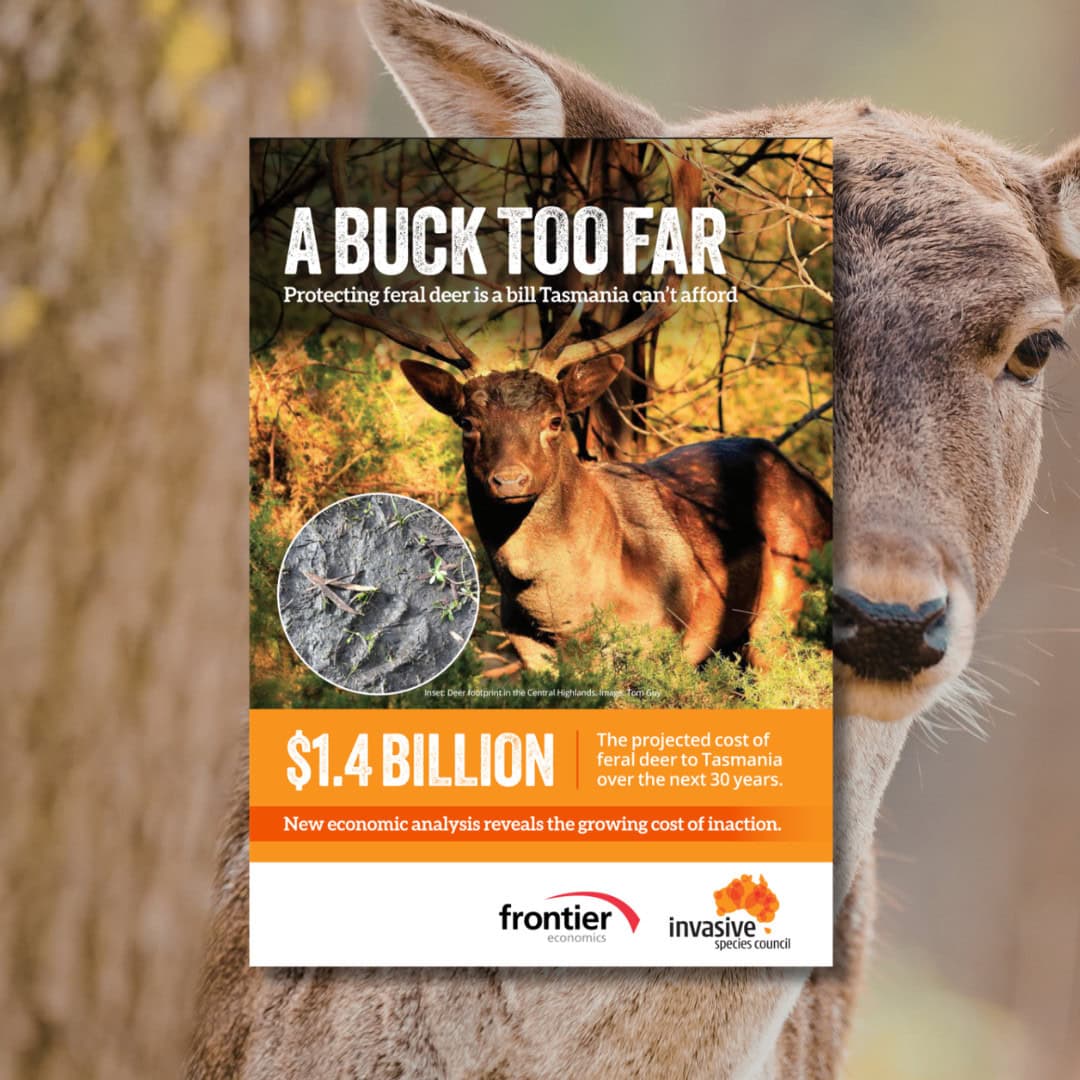
A buck too far: an analysis of the economic, social and environmental cost of deer in Tasmania
Feral deer are rapidly becoming one of Tasmania’s most costly invasive species. They are trashing our bushland, polluting our waterways,

Feral deer are rapidly becoming one of Tasmania’s most costly invasive species. They are trashing our bushland, polluting our waterways,
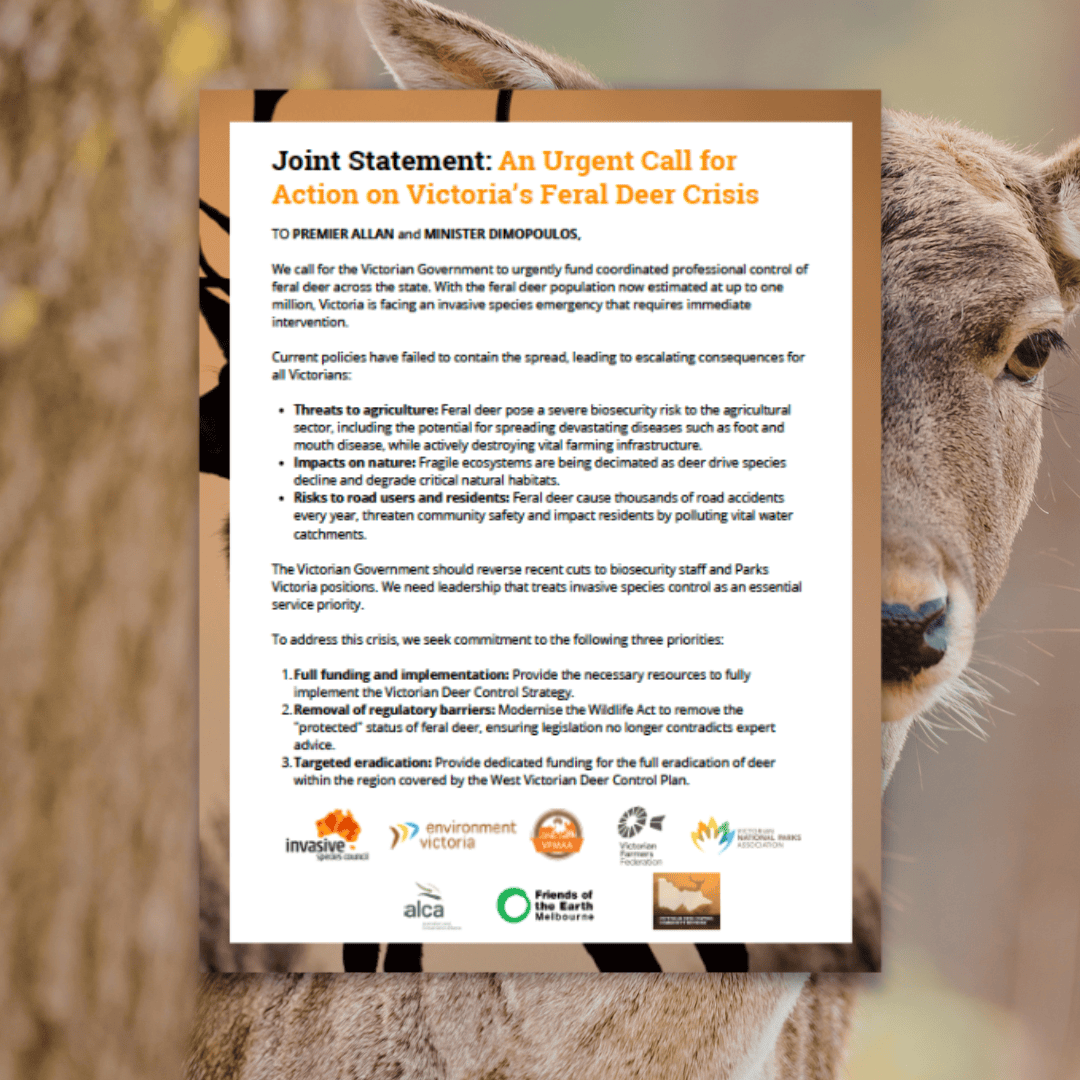
TO PREMIER ALLAN and MINISTER DIMOPOULOS, We call for the Victorian Government to urgently fund coordinated professional control offeral deer
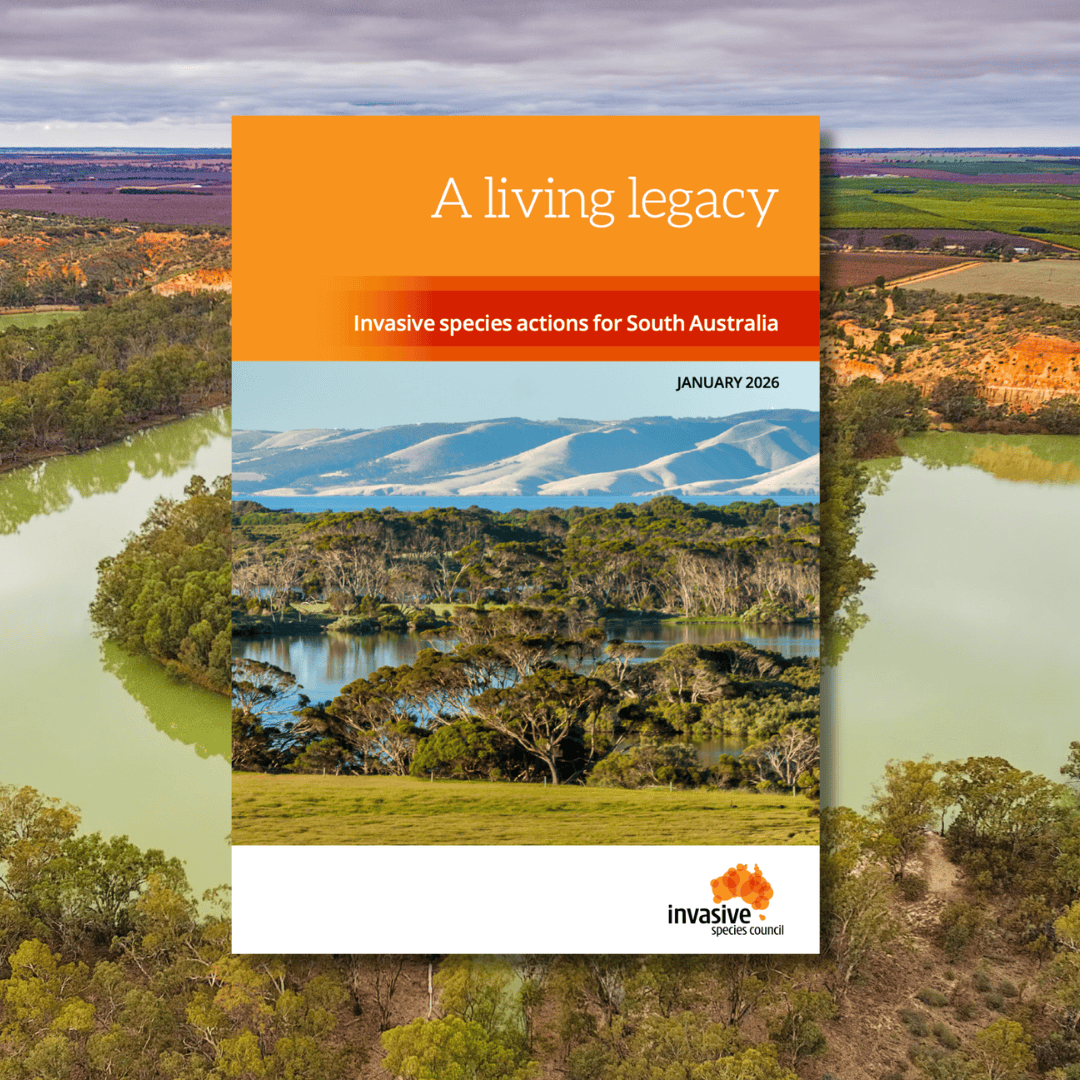
According to the South Australia State of the Environment Report 2023, invasive species remain a primary driver of biodiversity decline.
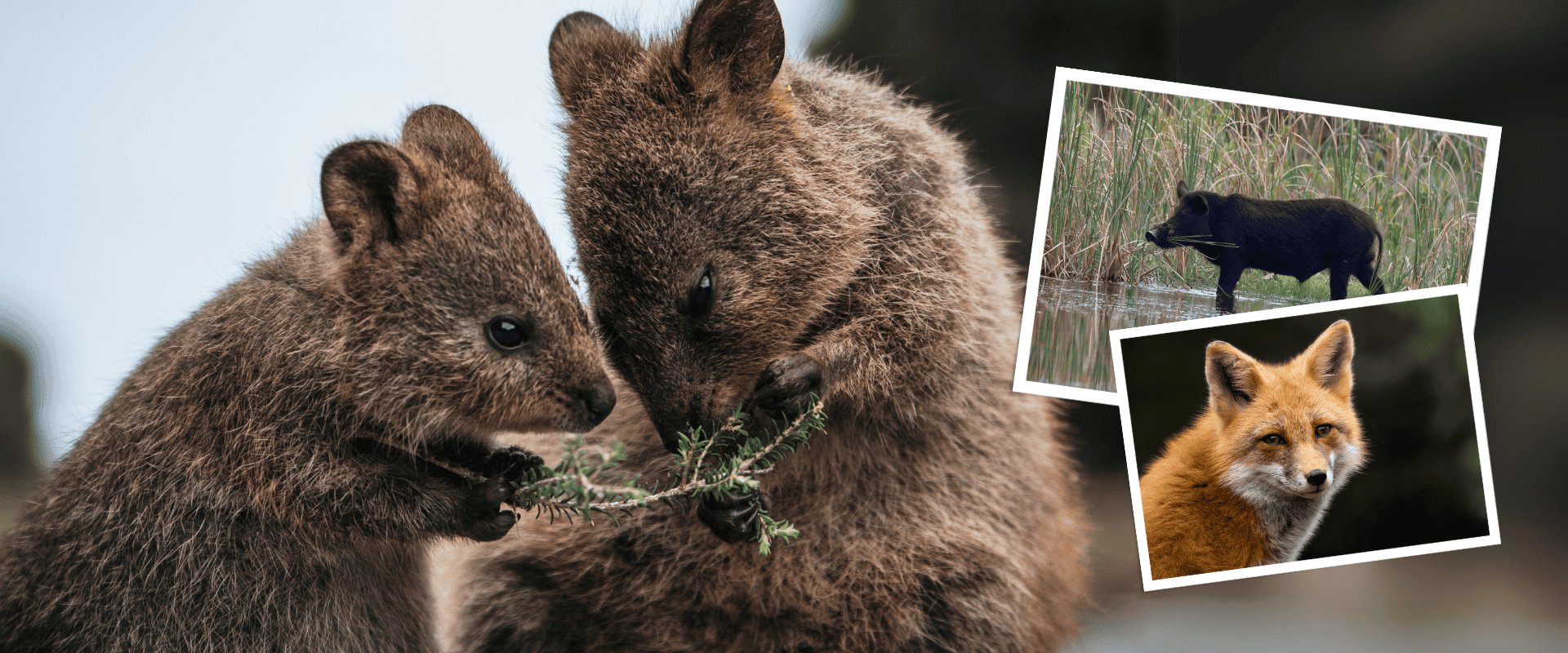
Every day our unique wildlife from numbats to night parrots – found nowhere else on Earth – are being pushed to the brink by invasive species. Our precious places are being trashed and trampled by feral animals and choked by weeds.

Nature in Queensland is a precious asset that must be protected.

Extinctions are holes torn in the fabric of life, and Australia is ragged from having so many species ripped out. This report examines the causes of modern extinctions in Australia to find that invasive species have caused the vast majority of losses since 1960.

How did the ‘independent survey’ of feral horse numbers conducted by brumby advocates measure up as a survey method? Should it replace the Distance Sampling method currently used by the NSW government?

Environmental organisations have written to Ministers and the Threatened Species Commissioner, seeking intervention on the imminent extinction of the galaxias species.
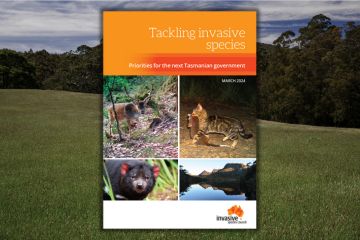
Tasmania is a remarkable island state with native animals and plants found nowhere else on earth, some of the most spectacular protected areas in Australia, and highly valued agriculture, forestry, and tourism sectors.

Invasive species are a major driver of extinction around the world. Controlling these species has proven difficult and expensive. A strategy that has been continually proposed is to commercialise the control of overabundant invasives, i.e. eat our way out of the invasive species problem. Unfortunately, this has many issues.
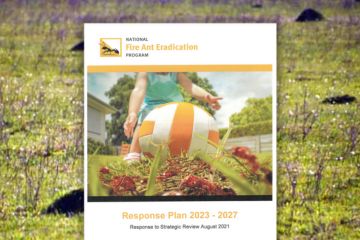
These documents, made public by the Invasive Species Council, outline the Queensland government’s fire ant eradication budget & work plan.

Red Imported Fire Ants (RIFA) are rightly considered a super-pest globally

Sustainable funding is critical for a strong biosecurity system and, therefore, protecting Australia’s economy, environment and communities.

The risks of the high pathogenicity avian influenza (HPAI) arriving in Australia and causing mass mortality of native birds and mammals are likely to have increased.
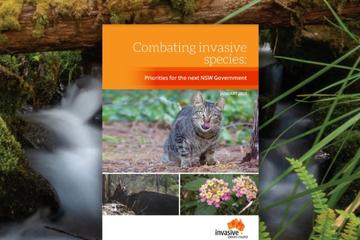
We face a crisis and current measures and resources in NSW are insufficient to halt and mitigate the impact of established invasive species and prevent the arrival and spread of new invasive species. In this document we detail priority actions the next NSW government can take that will strengthen the NSW biosecurity system and address priority environmental threats from invasive species.
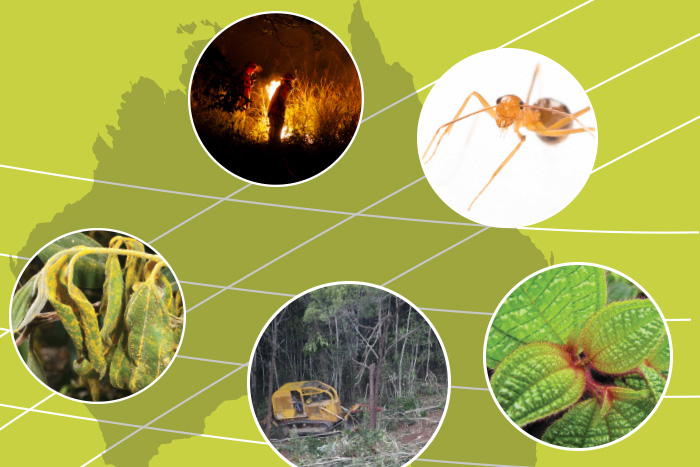
We are producing research and policy analysis to identify weaknesses in Australia’s island biosecurity and environmental legislation. Our report on Australia’s failure to abate biodiversity threats has numerous examples of how we are failing to protect our unique island biodiversity from invasive species.

June 2017
Eradicating red imported fire ants will be not only a major technical and scientific challenge but a governance one as well. The effectiveness of governance could make the difference between success and failure.

November 2017
With the Australian Government assuming responsibility for pre-border and border biosecurity there is now potential for Norfolk Island to be an exemplar in conservation-based island biosecurity.

October 2017
This report presents the result of surveys conducted by Ecology Australia for the smooth newt during the spring of 2016 in south-east Melbourne to help determine the ongoing persistence and spread of the species.

March 2017
Our best-practice environmental guide for Australian policy makers shows how we can create a biosecurity system that’s properly aimed at delivering real environmental protection on behalf of all Australians.

February 2017
Habitat loss is often assumed to be the main threatening process in Australia. This compilation of evidence demonstrates that invasive species are the main threat facing Australias declining mammals and frogs and, along with habitat loss and potentially climate change, represents one of the three main threats to biodiversity.
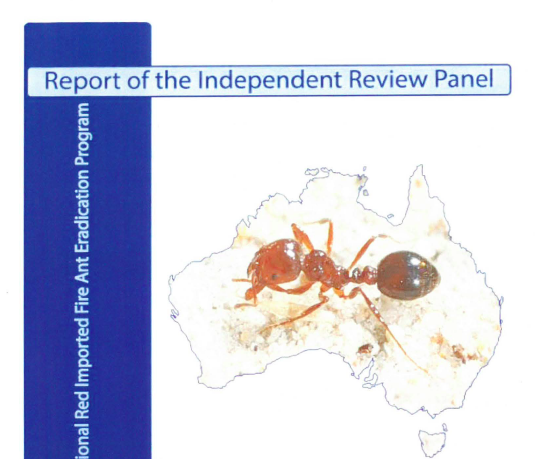
The final report of the independent review panel commissioned by the Agriculture Ministers’ Forum that reviewed the National Red Imported Fire Ant Eradication Program and outlined options for achieving eradication of red fire ants from south east Queensland.

Seven national priorities for invasive species reform that deliver long-term cost savings, stem biodiversity losses and enhance agricultural productivity.

Observation of Pest Horse Impacts in the Australian Alps, by Graeme Worboys and Ian Pulsford, illustrates the extent of the damage to the alpine national parks of NSW and Victoria.
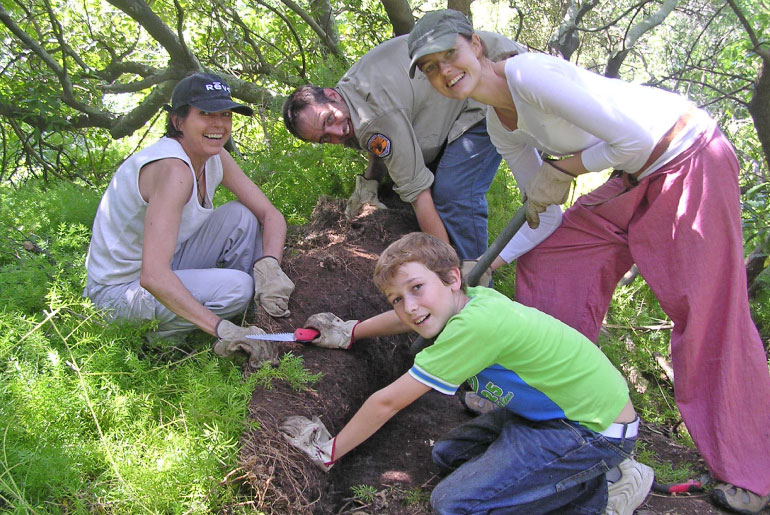
A paper prepared for the Biosecurity Advisory Council (reports to the federal minister for agriculture). This paper outlines the benefits and costs of community engagement in decision-making and policy-setting in environmental biosecurity, assesses the current state of engagement at the national level and makes recommendations for improvement.

May 2012
How can Australia stem the rising tide of environmental pests? By harnessing the energy and commitment of volunteers around the country under a new national organisation, Environment Health Australia.

August 2010
A report that calls for better weed laws, policies and funding in NSW to tackle weed invasions that are overwhelming authorities and landholders.

The weedy pasture plant tall wheat grass has the potential to invade more than half the state of Victoria and is putting numerous threatened species at risk. It is a far greater threat than the salinity problem it is meant to solve.
May 2009
A paper by WWF-Australia that outlines the strategic approach, design factors and policy objectives and instruments needed to construct a strong and effective national regulatory framework for weeds.

In Australia, invasive species are one of the most ubiquitous and severe threats to biodiversity. We are notorious for having lost by far the highest number of mammals in recent times, with foxes and cats in most of these extinctions.
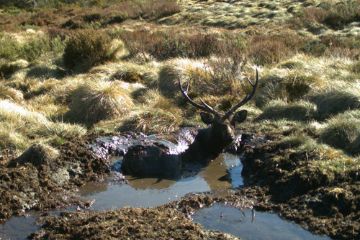
New report from Frontier Economics warns not controlling the impacts of feral deer in Victoria could cost the community $2.2 billion.
Australia was once a country where you could walk out at night and it was alive with wildlife scurrying and scrapping, digging and dashing. Australia’s nights are too quiet now.
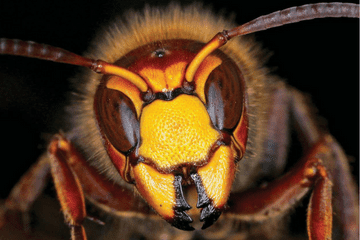
This document outlines initiatives and policies for the next Australian Government to keep our native wildlife safe from new and established invasive species.
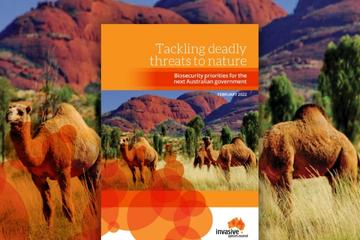
Initiatives and policies to improve Australia’s capacity to keep nature safe from new and established invasive species.
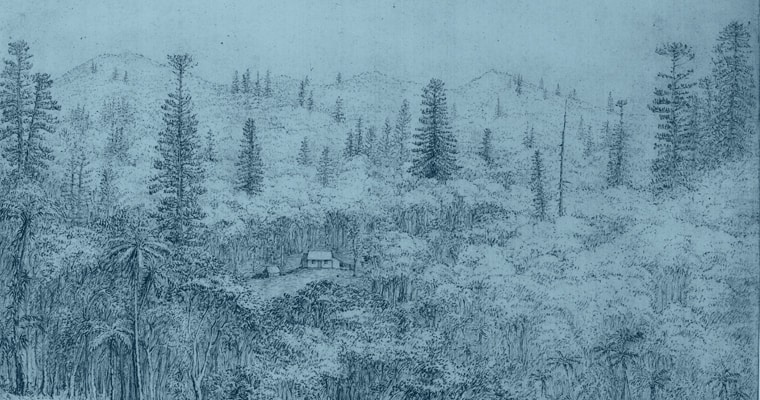
For the first time ever the native vegetation of Norfolk Island has been mapped, both as it exists now and before European arrival in 1750.
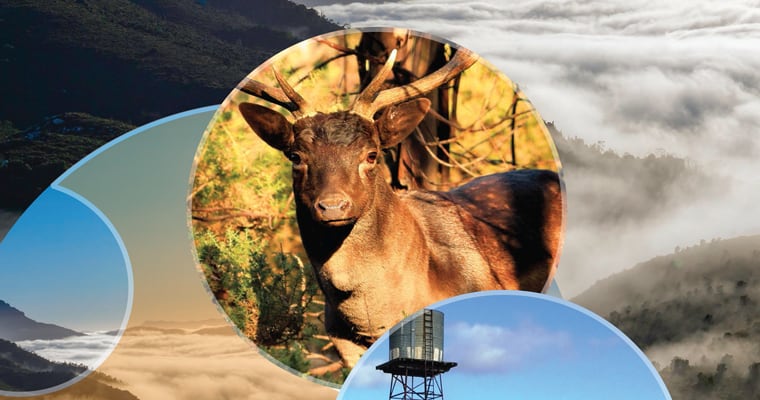
This strategy maps out a path for Tasmania to rapidly reduce increasing numbers of fallow deer and manage future numbers under a biosecurity-first approach.
This report applies an economic lens to the impacts growing numbers of feral horses in Kosciuszko National Park are having on the NSW economy.

This report by Tim Low explores the health and environmental implications of using glyphosate in Australia on crops and to stop weeds invading native ecosystems.

An analysis of the 2019-20 NSW bushfires on Kosciuszko National Park suggests that most areas home to high numbers of feral horses were unburnt.

This document provides a status report on invasive yellow crazy ant infestations in the Townsville area and options for their management. It arose from a roundtable meeting held in Townsville in November 2019.

A report into the ethical considerations of using 1080 to control feral animals has found the conservation benefits necessitate its use until an alternative is available.

A letter to the Prime Minister of Australia endorsed by 80 landcare, farming and conservation groups that provides a bridge to recovery jobs package to help with the recovery once it starts.

April 2020
An investigation into insects overseas that represent the greatest risks for Australia and how they could arrive in this country.

June 2019
Our Risks and Pathways Project set out to identify insect species from other countries that, if they ever reach Australia, have the potential to cause great harm to our natural environment.
December 2018
Strengthening environmental biosecurity – stopping new species arriving and establishing and limiting the harm caused by the worst invasive species – must be a priority of the highest order to save Australian species.