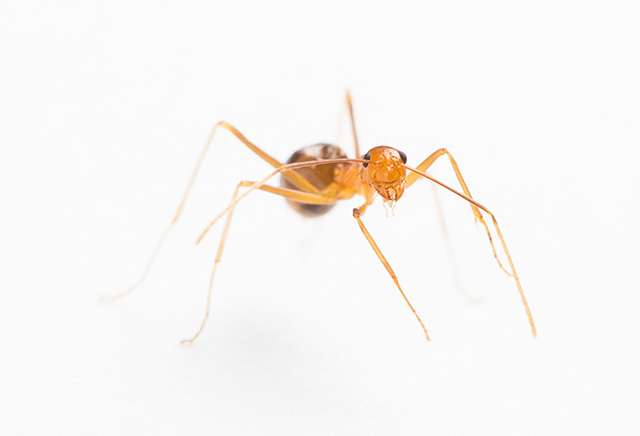
The Invasive Species Council has welcomed a major yellow crazy ant eradication milestone in Far North Queensland, saying the success shows what sustained investment can achieve – and why the federal government must prevent a looming Saving Native Species funding cliff in the budget in a few weeks.
The Wet Tropics Management Authority today announced a further 180 hectares have been declared free of yellow crazy ants, bringing the total area eradicated through the program to more than 1,255 hectares. An independent review last year found full eradication remains technically feasible and in the national interest – but only with ongoing funding.
Invasive Species Council Advocacy Director Reece Pianta said the milestone demonstrated the importance of funding continuity for invasive species eradication programs in the May federal budget.
‘This program is proving invasive species eradication works. Yellow crazy ants are being pushed back, World Heritage values are being protected, and years of investment are paying off.
‘But right as these results are being delivered, we are staring down a funding cliff in the upcoming federal budget that could put hard-won progress at risk.
‘An independent review made clear eradication is achievable – but only if funding continues. Walking away now would be like stopping a fire response while the flames are still burning.
‘The federal government must use this budget to extend and strengthen the Saving Native Species fund so successful programs like this don’t face uncertainty or disruption.
‘This is not the time to pull support from one of Australia’s standout invasive species success stories. It is time to secure the funding needed to finish the job.
‘If we are serious about preventing extinctions, this budget must back the programs that are already proving they work.’
Media inquiries: (02) 8006 5004
Background:
- YCA (Anoplolepis gracilipes) has been listed by the International Union for the Conservation of Nature as one of the world’s worst invasive species. It was identified in the national tramp ant threat abatement plan as one of six species of national priority. YCA are listed as restricted under category 3 of the Queensland Biosecurity Act 2014 and therefore must not be given away, sold, or released into the environment without a permit. Under the act’s ‘general biosecurity obligation’, everyone must take all reasonable and practical steps to minimise the risk from this ant.
- Yellow crazy ants are known to harm lizards, frogs, small mammals and turtle hatchlings. They are a highly invasive ant whose dense supercolonies dominate landscapes ecologically, displacing other insects and preying on small vertebrates as well.
- They are a highly aggressive species, and have made their way into Australia through our ports. After first arriving on Christmas island sometime before 1934, yellow crazy ants have since been recorded in Queensland, the Northern Territory and NSW. They now threaten areas like Queensland’s Wet Tropics World Heritage Area, the oldest continuously surviving tropical rainforests on the planet.
- Yellow crazy ants do not bite. Instead, they spray formic acid to blind and kill their prey. And although they’re tiny, they can swarm in great numbers, killing much larger animals like lizards, frogs, small mammals, turtle hatchlings and bird chicks and reshaping entire ecosystems.
- Overseas, in places like the Johnston Atoll National Wildlife Refuge in the middle of the Pacific Ocean, yellow crazy ants have killed and deformed large numbers of chicks in seabird colonies by constantly spraying them with acid.
- In 2022, funding commitments we won at the federal election were delivered in the national budget, this included $25m for Queensland’s yellow crazy ant eradication programs.
- Biosecurity Queensland continues to engage in surveillance and monitoring of YCA though it no longer considers full eradication possible in Queensland (Department of Agriculture and Fisheries, 2018). However, an ongoing localised eradication is underway in Cairns that has demonstrated considerable progress. A 2018 cost-benefit analysis of the Cairns eradication program found that the annual socioeconomic impact to the region of yellow crazy ants would exceed $700 million over the next seven years.
- YCA eradications can be successful if locally focussed and prioritised to areas where a risk profile exists for industry, people or environment. This can be an effective way to limit their damage locally and prevent YCA from spreading to other parts of Queensland.
Photo: David Wilson.
Related Content