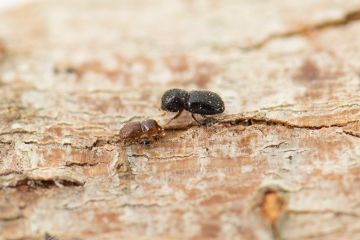
New research has revealed nearly half of Sydney’s urban trees could be vulnerable to one of the world’s most destructive invasive species – the polyphagous shot-hole borer – prompting urgent calls for surveillance and preparedness as it proliferates in the west.
The new risk mapping study has found 47% of Sydney’s urban trees are moderately to extremely susceptible, including iconic and ecologically vital species such as figs, paperbarks, banksias and eucalypts. This is based only on trees that have proved vulnerable in Western Australia and overseas, so the real risk is likely to be even higher.
The invasive beetle and the fungal disease it spreads, Fusarium dieback, have already devastated urban forests in Western Australia, where more than 4,000 trees were removed during a failed eradication effort that authorities abandoned last year after deciding it was no longer feasible.
‘This is a looming environmental disaster and these findings should be a wake-up call for all state governments outside of WA,’ Invasive Species Council Policy Director Dr Carol Booth said.
‘The substantial loss of tree canopies, whether in Sydney, Melbourne or Brisbane, would fundamentally reshape our cities – making suburbs hotter, reducing shade, beauty and habitat, and stripping away many of the trees that define their character.
‘Tree canopy is critical infrastructure, especially in places like western Sydney where temperatures are already extreme and worsening with climate change.
‘Losing large-scale canopy cover would have serious consequences for biodiversity, urban cooling, liveability and public health.
‘The vulnerability of some figs, paperbarks, sheoaks, banksias and eucalypts could also mean devastation of native forests and the wildlife that depends on these keystone species.
‘This needs to be treated with the same urgency governments are applying to threats like H5 bird flu. Waiting until the beetle is widespread will cost far more – environmentally, socially and economically.
‘Prevention and early intervention are our best chance of avoiding another environmental catastrophe.’
The Invasive Species Council is calling for urgent federal and state investment in surveillance and preparedness programs, alongside national risk mapping across other major urban centres.
Media inquiries: (02) 8006 5004
Background
About the beetle
- The polyphagous shot-hole borer is a 2-mm-long, southeast Asian beetle that has invaded 4 continents over the past 25 years. How it arrived in Australia is unknown. It may have entered within wooden products or wooden shipping materials. It was first detected by a member of the public in a garden tree in suburban Perth, and reported to the Western Australian Government in August 2021.
- The beetle is a fungus farmer. It tunnels into trees and sows fungal spores carried in a special pouch in its mouth parts. The fungi is food for its young, but can spread and infiltrate the tree’s vascular system, blocking the transport of water and nutrients and often causing branch or tree death.
- Native trees that have so far proved highly susceptible to the beetle and its fungus include swamp paperbark, river sheoak, Moreton Bay fig, Park Jackson fig, wedding bush, sea hibiscus (see HERE for the list).
- In South Africa, invaded a decade earlier than Australia, the beetle has invaded multiple forest types, often causing severe tree damage and death (URL). Biologists have predicted adverse effects to ecosystem functioning and resilience.
About the susceptibility of Sydney’s tree canopy
- The study was reported in the paper ‘Sentinel trees for early detection of non-native forest pests and pathogens in Australia’ by Dr Angus Carnegie (a forest research scientist with the NSW Government) and others (URL).
- They classified Sydney trees for their susceptibility to the polyphagous shot-hole borer based on species found to be moderately to extremely susceptible in Western Australia and other invaded countries.
- The researchers predict impacts that include an increased heat island effect, reduced amenity benefits impacting on human health, increased run-off and reduced air quality, and loss of biodiversity due to lost habitat for fauna, flora, insects and fungi, and reduced house prices.
Photo: DPIRD.
Related Content