The Invasive Species Council has welcomed today’s announcement that, for the first time, Australia’s national fire ant eradication program is moving inward to target the core infestation area after years of successfully suppressing fire ant populations on the invasion’s outer edges.
The Council said the milestone is the clearest sign yet that Australia’s eradication strategy is working, but warned governments not to repeat the costly mistake of underfunding the program as it approaches a major funding cliff in 2027.
Invasive Species Council Advocacy Director Reece Pianta said the progress showed eradication was working, but only because governments had finally begun investing at the scale experts had been calling for.
‘Australia has already run the experiment of underfunding fire ant eradication – and it failed. We should not repeat the same mistake in 2027.
‘Five years ago, governments penny-pinched on eradication and the infestation exploded by more than 40 per cent, growing from around 600,000 hectares to 850,000 hectares.
‘Millions of taxpayer dollars have since been spent chasing an invasion that should never have been allowed to spread so far and only now are we beginning to claw back the ground we lost.
‘Last year, an independent review found Australia’s fire ant eradication program was finally on track after receiving its first year of full funding – reinforcing that sustained investment is essential if eradication is to succeed.
‘Today’s announcement is proof that sustained investment works but funding uncertainty is already making it harder to plan the next stages of eradication.
‘Governments wouldn’t build half a bridge or put out half a fire and expect the job to stay done. Eradicating fire ants is no different. We’ve invested too much and come too far to stop just as the program is proving it can succeed.
Lockyer Valley Regional Council Mayor Tanya Milligan from the Council of Mayors SEQ said:
‘Fire ants have the potential to seriously harm people, pets and livestock, damage crops, destroy infrastructure and make parks, sporting fields and backyards unsafe.
‘Independent modelling estimates an established fire ant population would cost Australia at least $2 billion every year through agricultural losses, infrastructure damage, medical costs and reduced productivity, while also causing significant declines in native birds, mammals, reptiles and frogs.
‘Australia has already seen what happens when invasive pests get ahead of us. The cost of finishing this job will be far less than the cost of living with fire ants forever.’
‘Every state and territory has a stake in making sure this program succeeds because every state and territory will pay the price if eradication fails.’
‘Fire ants threaten our way of life and our national economy. This is a national challenge that requires a long-term national funding commitment – it cannot be left to local governments to carry the cost alone’
Media inquiries: (02) 8006 5004
Background
- The National Fire Ant Eradication Program is moving eradication treatments inward to target the core infestation area after years of successfully suppressing fire ant populations on the invasion’s outer edges.
- New suburbs across Ipswich, Lockyer Valley, Logan, Scenic Rim and Somerset have been added to the eradication treatment area, with additional suburbs in Brisbane, the Gold Coast and Moreton Bay to be included later this financial year.
- Last year, an independent review found Australia’s fire ant eradication program was on track after receiving its first year of full funding and recommended governments maintain long-term investment while strengthening the program’s next phase.
- Five years ago, experts warned the national eradication program required around $200 million a year, but governments funded it at around $60 million annually. During that period, the infestation expanded by more than 40 per cent, from around 600,000 hectares to 850,000 hectares.
- The current national funding agreement concludes in 2027. The Invasive Species Council is calling on all governments to commit long-term funding to complete eradication and avoid repeating the mistakes of the past.
- Fire ants have the potential to cost Australia at least $2 billion every year through agricultural losses, damage to homes and infrastructure, medical costs and reduced productivity if they become established.
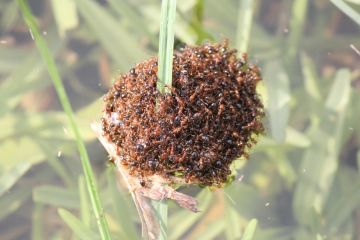
- Fire ants threaten native wildlife, agriculture, pets and livestock, and can spread through freight, soil and floodwaters. Almost every part of mainland Australia has a climate suitable for the invasive pest.
- Map here.
Related Content