A new independent review confirms the treatments used to combat fire ants pose minimal risk to human health when used as directed.
The review, conducted by independent toxicologists at SLR Consulting Australia, found no published peer-reviewed scientific evidence linking the treatment products used by the National Fire Ant Eradication Program to multiple chemical sensitivity or allergies.
The findings provide important reassurance for communities across south-east Queensland, and certainty in response to misinformation about treatment products.
The review examined scientific literature, technical reports and evidence from the US National Library of Medicine, including the potential human health impacts of the active ingredients pyriproxyfen and S-methoprene.
Both ingredients have been used around the world for decades, while the products used by the national program are approved and regulated by the Australian Pesticides and Veterinary Medicines Authority (APVMA).
Invasive Species Council Advocacy Director Reece Pianta said the independent findings should put to rest unfounded claims about the safety of fire ant treatments.
‘The science is clear. The treatments being used to eradicate fire ants are safe when used correctly, and now we have further independent evidence to back that up.
‘For too long, misinformation about fire ant treatments has been spreading through communities, creating unnecessary fear and undermining one of Australia’s most important biosecurity efforts.
‘People are understandably concerned about what is being applied to their properties, but they this accurate, science-based information proves that the frightening disinformation is not supported by evidence.
‘The real danger is the fire ants themselves. They can inflict painful stings, trigger life-threatening allergic reactions and pose a serious threat to our native wildlife, pets and livestock.
‘We have a rare opportunity to eradicate one of the world’s worst invasive species before it spreads across Australia, but that depends on communities having confidence in the treatments being used.
‘Fire ants don’t respect property boundaries. If even a small number of colonies survive because treatments are refused, they can reinfest surrounding areas and undo years of hard work.
‘These treatments are far more targeted than many of the chemicals people would otherwise be forced to use repeatedly if fire ants became permanently established across Australia.
‘The alternative to eradication isn’t a chemical-free future. It’s generations of Australians having to live with fire ants and manage them indefinitely.
‘We need Queenslanders working with the eradication program, not against it. Every property treated brings us closer to protecting Australian communities and wildlife from this devastating pest.’
‘The findings come at a critical time for Australia’s fire ant eradication effort, with the national program’s current funding due to expire in June 2027.
‘Australia has already spent more than two decades keeping fire ants contained to south-east Queensland. We now need to finish the job, backed by the science, community cooperation and sustained government investment.’
Media inquiries: (02) 8006 5004
Background:
- The independent review was conducted by SLR Consulting Australia for the National Fire Ant Eradication Program and assessed the potential human health impacts of fire ant treatment products.
- Separate research conducted by the Australia Institute found that the annual costs of pesticides to manage fire ants would be $581 million if they are not eradicated.
- The review found no published peer-reviewed scientific evidence linking the program’s treatment products to multiple chemical sensitivity or allergies and concluded they pose minimal risk to human health when used as directed.
- The active ingredients pyriproxyfen and S-methoprene are insect growth regulators that have been used internationally for decades.
- Products used by the National Fire Ant Eradication Program are approved and regulated by the APVMA.
- Australia’s agriculture ministers have agreed that fire ant eradication remains feasible, cost-beneficial and in the national interest.
- Fire ants are dark reddish-brown with a darker black-brown abdomen and range from two to six millimetres long. Their nests can appear as mounds of loose, crumbly or fluffy-looking soil, often with no obvious entrance holes.
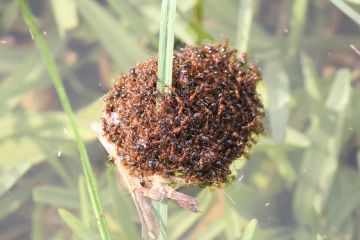
- During floods, fire ants can link together to form floating rafts containing thousands of ants and queens, allowing colonies to survive inundation and move with floodwaters.
- Fire ants can sting people, pets and livestock, kill native animals, damage crops and agricultural equipment and have major impacts on ecosystems.
- The National Fire Ant Eradication Program is currently funded until June 2027. Governments are considering the next phase of the national eradication response.
- Agriculture ministers have agreed that eradication remains feasible, cost-beneficial and in the national interest.
- Fire ants were first detected in south-east Queensland in 2001. Australia has prevented them from spreading nationally for more than two decades.
- A separate fire ant incursion detected at Sydney’s Enfield Intermodal Logistics Centre in September has been genetically confirmed as originating overseas and is not linked to the south-east Queensland infestation.
Related Content