
Help bring Australia's missing wildlife home
Help bring Australia's missing wildlife home
Together, we can give Australia’s wildlife a chance to live beyond the fence. Donate today.
Donate today to help bring the quoll home.
"*" indicates required fields
Your generous tax-deductible gift helps fund our fight to protect Australia’s native species.
For generations, eastern quolls were a familiar sight across Australia’s east coast, hunting through forests, farmland and even suburban backyards.
Then foxes and cats arrived. By the 1960s, the eastern quoll had disappeared from the mainland wild. Now, more than 60 years later, we’re losing it a second time.
Recent polling found that around one in three people in Queensland, NSW and Victoria no longer recognise the quoll as a native animal. One in six think the fox is.
The predator that helped drive the quoll from mainland Australia is now more familiar to many Australians than the quoll itself.
First, an animal disappears from our landscapes. Then, slowly, from our memories. And when we forget what we’ve lost, it becomes harder to fight for its return.
But this story isn’t over.
We know that when invasive predators are removed, quolls can return. And across Australia, protected sanctuaries are already showing us what’s possible.
Now we need to take that hope beyond the sanctuary fence, so quolls and other native wildlife can once again thrive across the landscapes they once called home.
Please give today to help bring the quoll home, and give Australia’s missing wildlife a chance to recover.
Donate today to help bring the quoll home.
"*" indicates required fields
Your generous tax-deductible gift helps fund our fight to protect Australia’s native species.
What we're doing
Fences and islands have saved some of Australia’s most threatened wildlife from extinction. They’ve given animals like the eastern quoll a second chance.
But they can’t be the end of the story. We want to see native wildlife thriving across whole landscapes, not just in protected pockets.
With your support, we’re working to make that happen.
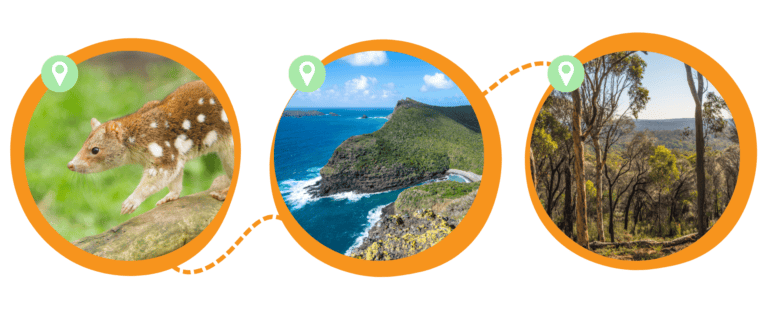
1. Creating safe havens for wildlife: Through our Rewilding Australia program, eastern quolls and parma wallabies are already living in a protected haven in the Shoalhaven, with southern brown bandicoots and long-nosed potoroos planned to follow.
2. Building new island refuges: We’re fighting for a national Islands of Hope program to remove feral cats, foxes and rats from priority islands, giving threatened wildlife more places to recover.
3. Taking recovery beyond the fence: By 2030, we’re working towards 50,000 hectares of fox-free mainland habitat for eastern quolls, while researching better ways to help native wildlife survive in landscapes where foxes remain.
None of this can happen without governments stepping up.
We’re a small, determined team working alongside researchers, Traditional Owners and local communities, while pushing governments across Australia for stronger laws, long-term funding and a properly coordinated national approach to feral cats and foxes.
Your donation will help us fight for the action needed to turn pockets of wildlife recovery into lasting change across Australia.
With your support, we win!
As Australia’s only full-time organisation dedicated to tackling invasive species, we’re fighting every day to protect our native wildlife. And with the support of people like you, we’ve helped secure some important wins for Australia’s wildlife.

Kangaroo Island's wildlife now have a fighting chance
Our advocacy helped remove outdated legal barriers to feral cat eradication on Kangaroo Island and secure funding to continue the work.

$100 million for threatened wildlife
Our advocacy helped secure a two-year, $100 million extension to the national Saving Native Species Fund, keeping vital conservation programs going across Australia.

Keeping the fight against feral animals going
Our advocacy helped secure continued funding for national coordinators tackling feral cats, foxes, deer and pigs.