The Invasive Species Council is calling on the Queensland government and Brisbane City Council to urgently develop a dedicated rapid response plan for the polyphagous shot-hole borer, warning Brisbane’s iconic urban trees could be highly vulnerable if the destructive invasive pest arrives in the state.
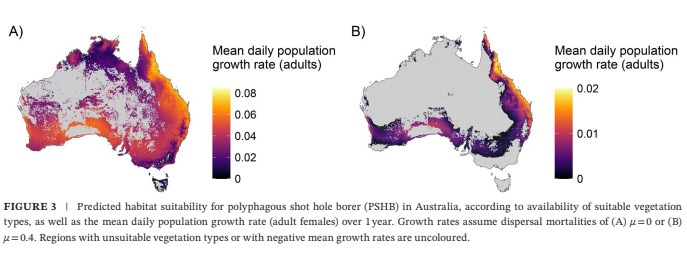
The warning comes amid growing concern among biosecurity experts about Queensland’s susceptibility to the beetle, particularly in south-east Queensland and the tropical north where climatic conditions are considered highly favourable for its establishment and spread.
Recent modelling has already found almost half of Sydney’s urban trees could be vulnerable to the pest and the deadly fungal disease it carries.
The polyphagous shot-hole borer has already devastated thousands of trees in Western Australia, where authorities were ultimately forced to abandon eradication efforts after the pest became too widespread to contain. More than 4,000 trees were removed during the failed response.
‘Brisbane’s iconic urban canopy could be in the firing line if this beetle arrives and we are not prepared,’ Invasive Species Council Advocacy Director Reece Pianta said.
‘Some of Queensland’s most recognisable trees, including Moreton Bay figs, are known hosts for this pest.
‘Places like New Farm Park are famous for their magnificent mature figs. Nobody wants to see those trees suffering the same fate as thousands of trees in Perth.
‘Western Australia has already shown us exactly what happens when governments are caught flat-footed. Thousands of trees have been lost and eradication ultimately failed.
‘Queensland needs a dedicated response plan before this pest arrives, not after.
‘The same climatic conditions that make south-east Queensland vulnerable also make large parts of north Queensland highly suitable for this beetle.
‘That means some of Australia’s most significant natural areas, including the Wet Tropics World Heritage Area, could also be at risk if this pest becomes established.
‘This is not just an urban forestry issue. It is an environmental biosecurity issue with potentially enormous consequences for native trees, wildlife habitat and culturally significant landscapes.
The beetle, originally from Southeast Asia, tunnels into trees and introduces a fungus that can block the movement of water and nutrients, causing branch dieback and often tree death.
‘Now established across multiple continents, it is considered one of the world’s most destructive tree pests due to its extremely broad host range and ability to kill mature trees.
‘Queensland should be planning now so that if the worst happens, everyone knows exactly what needs to occur in the first days and weeks of a response.
‘Once this beetle becomes widespread, the environmental, cultural and economic costs can be enormous. Our government needs to be ready to respond and quickly.’
The Invasive Species Council is calling on the Queensland government to immediately develop a polyphagous shot-hole borer rapid response plan, including:
- clear lines of responsibility between state and local government agencies
- rapid tree removal and containment protocols
- enhanced surveillance in high-risk areas
- preparedness exercises and emergency response arrangements
- targeted monitoring around ports, freight corridors and major urban centres.
Media contact: (02) 8006 5004
Background:
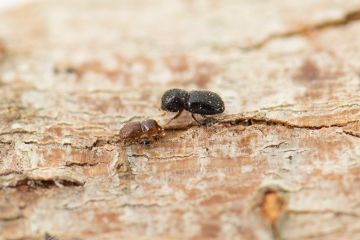
- The polyphagous shot-hole borer is a 2-mm-long, southeast Asian beetle that has invaded 4 continents over the past 25 years. How it arrived in Australia is unknown. It may have entered within wooden products or wooden shipping materials. It was first detected by a member of the public in a garden tree in suburban Perth, and reported to the Western Australian Government in August 2021.
- The beetle is a fungus farmer. It tunnels into trees and sows fungal spores carried in a special pouch in its mouth parts. The fungi is food for its young, but can spread and infiltrate the tree’s vascular system, blocking the transport of water and nutrients and often causing branch or tree death.
- Native trees that have so far proved highly susceptible to the beetle and its fungus include swamp paperbark, river sheoak, Moreton Bay fig, Park Jackson fig, wedding bush, sea hibiscus (see HERE for the list).
- In South Africa, invaded a decade earlier than Australia, the beetle has invaded multiple forest types, often causing severe tree damage and death (URL). Biologists have predicted adverse effects to ecosystem functioning and resilience.
Photo: DPIRD.
Related Content