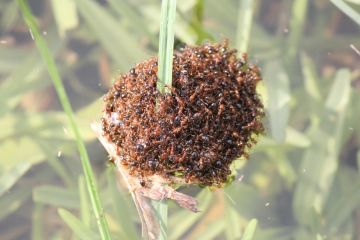
A new economic analysis has found completing Australia’s fire ant eradication program would return $35.60 in benefits for every $1 invested – even before many of the costs fire ants would impose on Australian households, wildlife and communities are counted.
The analysis, commissioned by the National Fire Ant Eradication Program, finds that without eradication, fire ants would spread through major population centres, agricultural regions and infrastructure networks, exceeding $1.4 billion annually by 2038.
But the Invasive Species Council says even those figures significantly understate the true cost of allowing fire ants to spread as it excludes costs associated with pet injuries, biodiversity loss, public parks and tourism.
‘For every $1 governments invest in finishing the job on fire ants, Australia stands to receive $35.60 in benefits,’ Invasive Species Council Advocacy Director Reece Pianta said.
‘That is an extraordinary return on investment – and the real return is likely to be even greater because this analysis simply can’t put a dollar figure on everything we stand to lose.
‘It doesn’t fully capture what families would spend treating their backyards year after year, the cost of fire ants injuring and killing pets, or the damage they would do to our national parks, wildlife and public greenspaces.
‘Australians would be paying for fire ants for generations. We can either invest in eradication now or accept enormous and permanent costs across virtually every part of the country.’
The analysis reveals infrastructure damage is a particularly significant part of the fire ant threat.
Fire ants are attracted to electrical and telecommunications equipment, where they can accumulate in large numbers, cause short circuits and damage components. The report identifies transformer units, signal control boxes and telecommunications equipment among the infrastructure at risk.
By 2038, the annual cost of damage to electricity and telecommunications infrastructure alone is estimated to reach $237 million, while annual agricultural impacts are estimated to exceed $1 billion.
‘Fire ants can get into electrical equipment, transformers and telecommunications infrastructure, causing failures, damage and ongoing maintenance costs,’ Mr Pianta said.
‘This new analysis shows the infrastructure threat is enormous, while the cost to agriculture alone could exceed $1 billion a year by 2038.
‘And these are only the costs economists have been able to put a reliable dollar figure on.’
The analysis also provides updated modelling of how fire ants could spread if the national eradication effort stopped.
It finds human-assisted movement could rapidly carry fire ants around the country, with freight, transport and industrial areas particularly important in long-distance spread. The model identifies 41 major freight hubs – including ports, airports and industrial precincts across every mainland state and territory – as key nodes where fire ants could jump large distances through the movement of infested materials.
Without the eradication program, modelling projects fire ants could affect areas containing 10.4 million Australians by 2042 and almost 25 million by 2057, as well as 340 million hectares of agricultural land by 2057.
‘The updated spread modelling shows why this is a national problem, not a Queensland problem,’ Mr Pianta said.
‘Australia’s freight network gives fire ants pathways to hitchhike enormous distances. Once they reach new population centres and agricultural regions, the cost and difficulty of managing them grows dramatically.
‘We have a genuine opportunity to eradicate fire ants. Walking away from that now would mean choosing decades of damage and billions of dollars in avoidable costs.
‘Australia’s treasurers now have one of the clearest investment cases they could ask for. The economics says: let’s finish the job.’
Media inquiries: (02) 8006 5004
Background:
- The current national fire ant eradication program is funded until June 2027.
- Recently agriculture ministers from across the country made a united commitment to keep fire ant eradication on the table, saying the next critical test is whether state, territory and federal treasurers will fund the plan.
- A proposed Response Plan 2027–32 would continue the eradication effort over the following five years, subject to funding commitments from Australian, state and territory governments.
Related Content