Living in a warmer, wilder, weedier world
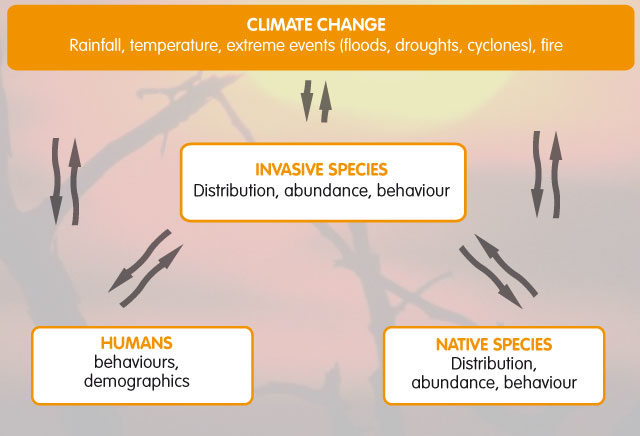
Climate change is expected to drive some native plants and animals to extinction by making their homes too hot or dry and leaving them nowhere to go. But for many species, an earlier and greater danger is that climate change will help invasive species spread and do more harm.
Invasive species are already the main cause of extinctions in Australia, especially of animals. They are also a major cause of declining native species and damage to ecosystems and First Nations culture. A national assessment found that, in many cases, invasive species helped by climate change are likely to do more harm than climate change itself [1].
Australian animals lost to invasive species
- 36 of 40 extinct mammal species, mostly due to cats and foxes (31 species), with the rest lost to black rats, a parasite they carry, and wolf snakes. Across much of Australia, most native mammals weighing 35 grams to 5.5 kilograms have vanished. Some survive only on islands free of cats and foxes, or behind fences.
- 4 of 8 extinct bird species, mainly killed by black rats on islands.
- All 6 extinct frog species, due to disease caused by chytrid fungus.
- All 3 extinct lizard species (one extinct, 2 surviving only in captivity), killed by wolf snakes on Christmas Island.
- Both extinct fish species, one extinct in the wild due to predation by brown trout and one probably lost to an introduced disease.
Sources: [2–5]
Why invasive species will gain
Climate change will create winners and losers, and invasive species will be among both. Cane toads are expected to spread further south, while higher temperatures will make it harder for rabbits to breed [6,7]. But overall, invasive species are likely to cause more harm, for several reasons.
- They adapt. Many invasive species are generalists that cope with, or exploit, change and disturbance [8,9]. Many weeds, for example, are weedy because they grow across a wide range of climates.
- Extreme events open doors. Weeds colonise ground bared by drought, fire and cyclones, and foxes and cats hunt animals that have lost their shelter [10–12]. Floods carried carp through the Murray–Darling river system, where they now dominate, and spread athel pine hundreds of kilometres along the Finke River in central Australia [13,14].
- Native species will be weakened. Plants and animals stressed by heat, drought or other impacts of climate change are less able to compete with invaders or resist disease. During drought, for example, southern hairy-nosed wombats are more prone to mange caused by an introduced mite [15]. When native plants die, fast-growing weeds often take their place [16]. The reverse is also true: species already under pressure from cats, foxes, goats or deer will be less able to adapt to a changing climate.
- Weeds attract birds needed by native plants. To shift in response to climate change, many native plants rely on birds to disperse their seeds. But birds such as currawongs, figbirds and silvereyes often now feed instead on the fruit of weeds like camphor laurel and privet, spreading weed seeds instead.
- Control efforts will weaken. Farmers struggling with extreme weather, and governments facing other climate costs, are likely to spend less on controlling invasive plants and animals [17]. Some herbicides, including glyphosate, and some biological control agents are predicted to operate less effectively [18,19].
- Our responses can create new invaders. Hardier, drought-tolerant varieties of plants that are already weedy, invasive biofuel crops such as giant reed, and farming moving north into new regions all bring new risks of invasion [20,21].
How climate change will make invasions worse
More fire: In northern and central Australia, gamba, buffel and other invasive pasture grasses fuel fierce fires hot enough to kill trees, perpetuating tan expanding dominance [22,23]. More frequent fire under climate change will speed this process.
Warmer and wetter: At least 65 native plants are at ‘very high’ risk of extinction from the devastating disease, Phytophthora dieback [24]. Its spores travel in flowing water, so more summer rain in the south-west and warming in subalpine areas in the south-east would favour its spread, risking more extinctions [25].
Stronger cyclones in the tropics: Gardens in Queensland’s Wet Tropics hold many exotic rainforest plants that have not yet escaped. Cyclones that damage forests and cause flooding could give them an opening to invade [12].
Warmer mountains: As the climate warms, foxes are moving higher in the Australian Alps, threatening the endangered mountain pygmy-possum and broad-toothed rat. Weeds will move upslope too [12,26].
Warmer water: Most aquarium fish come from the tropics. As rivers and lakes warm, more become suitable for fish that escape or are released [27,28].
Invaders that heat the planet
Some invasive species add to climate change, although this has had little research. (A few have the opposite effect [29].)
Introduced insects and plant diseases have the potential to turn some forests from carbon stores into carbon sources [35]. If myrtle rust spreads to all suitable areas in Australia, it could reduce national carbon sequestration by 1.6%, an annual value loss of more than $340 million [36].
Flammable grasses such as gamba grass, mission grass and buffel grass drive hotter, more frequent fires that kill trees, which means less carbon stored [22,30].
Some weeds speed the release of carbon from soil [31]. Willows growing in wetlands release methane drawn from the mud [32]. Introduced earthworms can also reduce soil carbon [30].
Feral grazing animals – buffalo, pigs, goats, deer, donkeys, horses and cattle – produce the greenhouse gases methane and nitrous oxide. By damaging wetlands and trees and stopping forests from regrowing, they may also reduce carbon stores [30,33,34].
Problems that feed themselves
Some interactions between invasive species and climate change are especially worrying because each problem makes the next one worse.
- Grass and fire: Gamba, buffel and other invasive pasture grasses fuel intense fires, then spread in their wake [22]. As climate change brings more fire, the result is more grass, more dead trees and more emissions.
- Cyclones and vines: Cyclone damage lets exotic vines such as blue thunbergia and turbina smother rainforest. The vines stop the canopy recovering, leaving the forest more exposed to the next cyclone [12].
- Disease and drought: Phytophthora dieback leaves trees less able to survive drought and fire. Dead trees release carbon, and weeds take their place.
- Despair and inaction: The more invasive species take hold, the more people feel the problem is too big to tackle. Climate change deepens that sense of hopelessness. Keeping people motivated is itself a climate challenge.
How to respond
Invasive species are likely to cause more extinctions in Australia even without climate change. Climate change makes dealing with them more urgent. We need to:
- Help native species adapt by reducing the invasive threats they already face, especially for species likely to decline under climate change, and in places likely to become climate refuges.
- Target invaders likely to benefit from climate change – for example, by removing potential weeds from trade, and by focusing research and control on plant diseases and flammable pasture grasses.
- Prevent harmful new introductions, including those caused by our responses to climate change. This means allowing species to be released only if assessed as low risk (a ‘permitted list’ approach), and assessing the invasive risks of new varieties and breeds of invasive species, biofuel crops, other species proposed for widespread planting, and native species moved to new areas.
- Control invasive species that add to emissions, such as flammable weeds and feral grazing animals, and make sure plants used for carbon offsets and biofuels are not invasive.
1. Steffen W. Australia’s biodiversity and climate change. CSRIO Publishing; 2009.
2. Woinarski JC, Legge SM, Moseby K, Burbidge AA, Carthey AJ, Dickman CR, et al. Investigating the causes of an extinction catastrophe: controlling introduced predators remains essential for conserving Australia’s mammals. BioScience. 2026; biaf204.
3. Woinarski J, Braby M, Burbidge A, Coates D, Garnett S, Fensham R, et al. Reading the black book: The number, timing, distribution and causes of listed extinctions in Australia. Biol Conserv. 2019;239: 108261.
4. Low T, Booth C. GONE: Australian animals extinct since 1960. Invasive Species Council; 2024. Available: https://invasives.org.au/wp-content/uploads/2024/11/Gone-Report-Updated-2024.pdf
5. Woinarski JC, Tiernan B, Legge SM. Should the Christmas Island shrew (Crocidura trichura) be considered extinct? Aust Mammal. 2023;46.
6. Kearney M, Phillips BL, Tracy CR, Christian KA, Betts G, Porter WP. Modelling species distributions without using species distributions: the cane toad in Australia under current and future climates. Ecography. 2008;31: 423–434.
7. Marai IFM, Habeeb AAM, Gad AE. Rabbits’ productive, reproductive and physiological performance traits as affected by heat stress: a review. Livest Prod Sci. 2002;78: 71–90.
8. Rejmánek M. A theory of seed plant invasiveness: the first sketch. Biol Conserv. 1996;78: 171–181.
9. Sutherst RW, Baker RHA, Coakley SM, Harrington R, Kriticos DJ, Scherm H. Pests under global change — meeting your future landlords? In: Canadell JG, Pataki DE, Pitelka LF, editors. Terrestrial Ecosystems in a Changing World. Springer; 2007. pp. 211–226.
10. Friend GR. Impact of fire on small vertebrates in mallee woodlands and heathlands of temperate Australia: a review. Biol Conserv. 1993;65: 99–114.
11. Clarke MF. Catering for the needs of fauna in fire management: science or just wishful thinking? Wildl Res. 2008;35: 385–394.
12. Low T. Climate change and invasive species: a review of interactions. Biological Diversity Advisory Committee, Australian Government Department of the Environment; 2008.
13. Koehn J, Brumley AR, Gehrke PC. Managing the impacts of carp. Bureau of Rural Sciences; 2000.
14. Agriculture & Resource Management Council of Australia & New Zealand and Australian & New Zealand Environment & Conservation Council and Forestry Ministers. Weeds of National Significance Athel Pine (Tamarix aphylla) Strategic Plan. National Weeds Strategy Executive Committee; 2000.
15. Ruykys L, Taggart DA, Breed WG, Schultz D. Sarcoptic mange in southern hairy-nosed wombats (Lasiorhinus latifrons): distribution and prevalence in the Murraylands of South Australia. Aust J Zool. 2009;57: 129–138.
16. Groves RH, Willis AJ. Environmental Weeds and Loss of Native Plant Biodiversity: Some Australian Examples. Australas J Environ Manag. 1999;6: 164–171.
17. West P, Saunders G. Pest animal survey 2004-2006: A Review of the Distribution, Impacts and Control of Invasive Animals Throughout NSW and the ACT. NSW Department of Primary Industries; 2007.
18. Johns CV, Hughes L. Interactive effects of elevated CO2 and temperature on the leaf‐miner Dialectica scalariella Zeller (Lepidoptera: Gracillariidae) in Paterson’s Curse, Echium plantagineum (Boraginaceae). Glob Change Biol. 2002;8: 142–152.
19. Ziska LH, Runion GB. Future weed, pest, and disease problem for plants in Agroecosystems in a Changing Climate, edited by Newton, PCD, Carran, RA, Edwards GR & Niklaus PA. Taylor & Francis Boca Raton; 2007.
20. Booth C, Carr G, Low T. Weedy pasture plants for salinity control: sowing the seeds of destruction. Invasive Species Counc. 2009. Available: https://invasives.org.au/wp-content/uploads/2014/02/rpt_weedypastureplants.pdf
21. Low T, Booth C. The weedy truth about biofuels. Invasive Species Council; 2007.
22. Rossiter NA, Setterfield SA, Douglas MM, Hutley LB. Testing the grass‐fire cycle: alien grass invasion in the tropical savannas of northern Australia. Divers Distrib. 2003;9: 169–176.
23. Bowman T. Ecosystem degradation, habitat loss and species decline in arid and semi-arid Australia due to the invasion of buffel grass. Key threatening process nomination. Australian Government Department of Climate Change, Energy, the Environment and Water; 2024.
24. McDougall KL, Barrett S, Velzeboer R, Cahill DM, Rudman T. Evaluating the risk to Australia’s flora from Phytophthora cinnamomi. Aust J Bot. 2024;72: BT23086.
25. Department of the Environment and Energy. Background document: Threat abatement plan for disease in natural ecosystems caused by Phytophthora cinnamomi. Australian Government; 2018.
26. McDougall KL, Morgan JW, Walsh NG, Williams RJ. Plant invasions in treeless vegetation of the Australian Alps. Perspect Plant Ecol Evol Syst. 2005;7: 159–171.
27. Corfield J, Diggles B, Jubb C, McDowall R, Moore A, Richards A, et al. Review of the impacts of introduced ornamental fish species that have established wild populations in Australia. Prepared for the Australian Government Department of the Environment, Water, Heritage and the Arts. 2008 p. 277.
28. Ebner B, Millington M, Holmes B, Wilson D, Sydes T, Bickel T, et al. Scoping the biosecurity risks and appropriate management relating to the freshwater ornamental aquarium trade across northern Australia. Centre for Tropical Water and Aquatic Ecosystem Research, James Cook University; 2020.
29. Wolkovich EM, Lipson DA, Virginia RA, Cottingham KL, Bolger DT. Grass invasion causes rapid increases in ecosystem carbon and nitrogen storage in a semiarid shrubland. Glob Change Biol. 2010;16: 1351–1365.
30. Peltzer DA, Allen RB, Lovett GM, Whitehead D, Wardle DA. Effects of biological invasions on forest carbon sequestration. Glob Change Biol. 2010;16: 732–746.
31. Strickland MS, Devore JL, Maerz JC, Bradford MA. Grass invasion of a hardwood forest is associated with declines in belowground carbon pools. Glob Change Biol. 2010;16: 1338–1350.
32. Smialek J, Bouchard V, Lippmann B, Quigley M, Granata T, Martin J, et al. Effect of a woody (Salix nigra) and an herbaceous (Juncus effusus) macrophyte species on methane dynamics and denitrification. Wetlands. 2006;26: 509–517.
33. Davies HF, Murphy BP, Duvert C, Neave G. Controlling feral ruminants to reduce greenhouse gas emissions: a case study of buffalo in northern Australia. Wildl Res. 2023.
34. Mihailou H, Massaro M. An overview of the impacts of feral cattle, water buffalo and pigs on the savannas, wetlands and biota of northern Australia. Austral Ecol. 2021;46: 699–712.
35. Seidl R, Klonner G, Rammer W, Essl F, Moreno A, Neumann M, et al. Invasive alien pests threaten the carbon stored in Europe’s forests. Nat Commun. 2018;9: 1626.
36. Le TP, Theng M, Baker CM, Abell IR, Kompas T, Hudgins EJ. Estimating the impact of invasive pests and diseases on ecosystem services: modelling carbon sequestration loss due to myrtle rust (Austropuccinia psidii exotic strains) in Australia. Ecosyst Serv. 2026;81: 101889.
Related Content