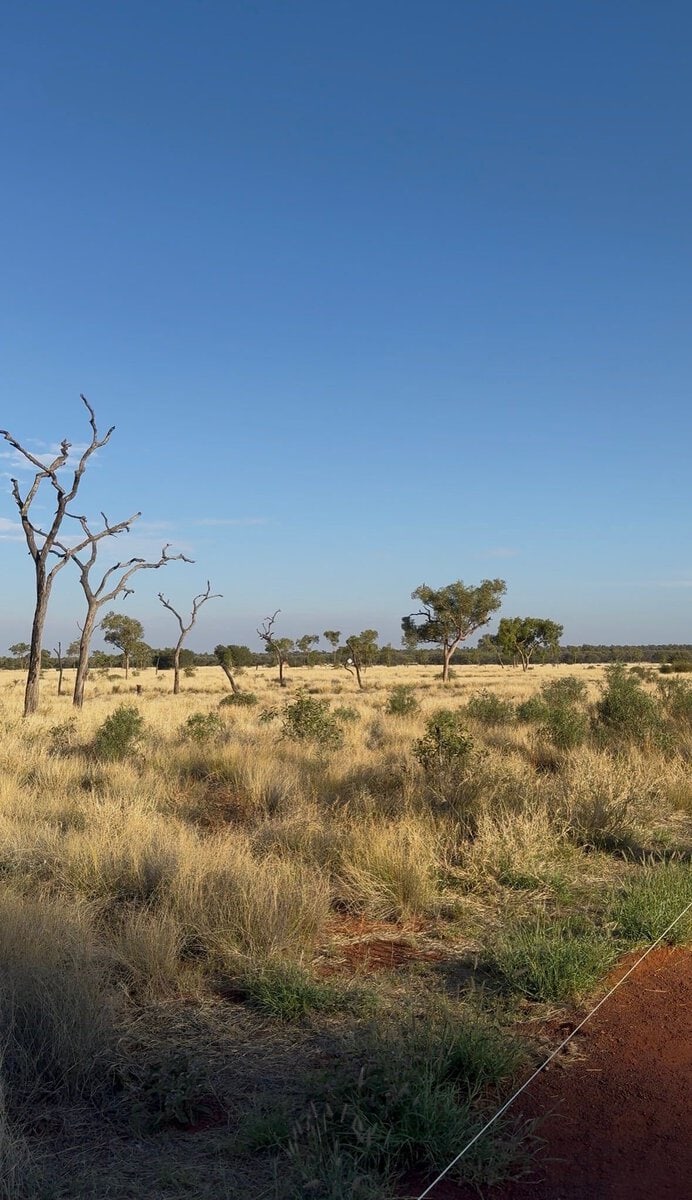
The Invasive Species Council has warned South Australia is abandoning its frontline defence against one of the state’s most destructive invasive species, with funding for the State Buffel Grass Coordinator position set to run out from today on 1 July.
The role, hosted by the Alinytjara Wilurara Landscape Board, helps coordinate efforts to tackle buffel grass across remote South Australia. The cut comes as seasonal rainfall is driving new outbreaks of the invasive weed across northern parts of the state and along major transport corridors.
The Invasive Species Council, the Australian Land Conservation Alliance, the Conservation Council SA, Bush Heritage Australia, Australian Wildlife Conservancy, Nature Foundation and Arid Recovery are calling on the Malinauskas Government to urgently secure ongoing funding for the coordinator position and formally adopt and fund the State Buffel Grass Strategy, which was drafted in 2024 but has yet to be implemented.
Invasive Species Council’s Senior Advocate James Johnston said allowing the role to disappear now would leave South Australia dangerously exposed as buffel grass is actively advancing across 40 per cent of the state.
‘Buffel grass is transforming native landscapes, fuelling hotter and more frequent fires, damaging culturally significant places and pushing wildlife out of the habitats they depend on.
‘Right now this threat is spreading across the state, turning our ecosystems into monocultures and putting South Australian communities at risk – yet the state government is defunding action, right when it should be scaling it up.
‘We commend the Alinytjara Wilurara Landscape Board for their determination to protect 26 per cent of our state’s landmass, but they cannot fight this cross-portfolio threat alone.
‘We are urging the Malinauskas Government to back its own strategy with real investment. Securing ongoing funding for the State Buffel Grass Coordinator role should be the first step in a much more ambitious response to one of the state’s most damaging invasive species.’
Australian Wildlife Conservancy CEO, Tim Allard said the SA Government’s failure to fund this program is a clear failure to meet its responsibilities to regional and remote communities. Invasive species are now the primary threat – not only to biodiversity, but to agricultural productivity and long-term food security.
‘Withdrawing this funding will unwind years of coordinated effort and allow this problem to escalate rapidly. The Government now has a straightforward choice: step up, show leadership, and secure this critical coordination function or allow the situation to deteriorate further, at far greater cost to communities, industry and the environment.’
Conservation Council SA Chief Executive Kirsty Bevan said buffel grass is rapidly spreading across South Australia, increasing fire risk, displacing native species, and exposing a serious failure in funding and coordination.
‘Land managers are doing everything they can on the ground, but without the resources to fully implement the State Buffel Grass Strategy, their efforts are being undermined. Conservation SA is calling for a properly funded, coordinated response that matches the scale and urgency of this growing threat.’
Australian Land Conservation Alliance Policy Lead Michael Cornish said: buffel grass is transforming Australian landscapes and threatening biodiversity, cultural values, and fire safety. Without stronger and coordinated action on buffel grass, South Australian landscapes will face escalating threats. We need the state government to demonstrate their commitment.
‘This isn’t a remote issue. This crisis is no longer confined to the north of the state – left unchecked, buffel grass seeds are being brought down freight routes spread by heavy freight transport, establishing a front as far south as Port Pirie and aggressive infestations in suburbs within Adelaide.
‘Without wash-down protocols and roadside containment lines, metropolitan Adelaide will inevitably become a vector hub, spreading the weed irreversibly across the rest of the state.’
Bush Heritage Australia Healthy Landscape Manager, Dr Graeme Finlayson said from an ecological standpoint, the proliferation of buffel grass fundamentally alters native vegetation structures, outcompeting critical chenopod shrublands and preventing the recruitment of long-lived perennial species.
‘While our teams use targeted chemical and physical treatment to remove infestations on our reserves and near the boundary, individual landholder action cannot solve this crisis.
‘Without a permanent State Coordinator to enforce cross-tenure containment protocols along primary national freight corridors, individual conservation investments remain highly vulnerable to continuous seed re-invasion.
‘A dedicated coordinator is also critical for a collaborative approach at a broader scale, as well as driving future innovation such as broadscale mapping and detection with remote sensing, and research to improve how we manage this declared weed.’
Nature Foundation CEO, Alex Nankivell said our current fundraising initiatives are specifically targeting philanthropic capital to finance aggressive buffel grass containment, reflecting the critical threat this weed poses to the biodiversity of our Witchelina and Hiltaba Nature Reserves.
‘Private donor funds are being deployed directly into intensive mapping and chemical suppression to defend specialized micro-habitats required by vulnerable species, including the Plains-wanderer and Thick-billed Grasswren.
‘However, philanthropic investments cannot substitute for systemic state biosecurity infrastructure.
‘While our donors are actively funding the field operations required to exclude this invasive weed from high-conservation zones, these localized efforts are highly vulnerable if the state allows its centralized coordination and highway vector controls to break down on July 1.’
Arid Recovery CEO, Lauren Young said the removal of funding for the Buffel Grass Coordinator significantly heightens both environmental risk and the likelihood of increased fire activity, particularly in regions that are not naturally fire-prone. As buffel grass spreads, it alters fuel loads and fire behaviour, introducing a level of risk that threatens ecosystems not adapted to frequent or intense fire.
‘Effective management of buffel grass depends on a coordinated, landscape-scale approach. Without a dedicated coordinator to guide and align efforts across tenures, management will become fragmented, reactive, and ultimately far less effective.
‘The loss of this critical role will result in ad hoc and inefficient control efforts, undermining the considerable investment already made by land managers, and allowing ongoing spread and reinfestation.
‘Reinstating funding for a Buffel Grass Coordinator is essential to ensure a strategic, collaborative response that protects both biodiversity and community safety.’
Media inquiries: (02) 8006 5004
Background:
- Buffel grass (Cenchrus ciliaris) is a highly invasive, deep-rooted perennial grass that acts as an ecosystem transformer, burning with unprecedented heat (up to 300°C hotter than native grass fires) that kills native trees and desert vegetation.
- The State Buffel Grass Coordinator position is hosted by the Alinytjara Wilurara Landscape Board—the nation’s only all-Aboriginal natural resource board—which covers remote areas including the APY Lands, Maralinga Tjarutja, and the Nullarbor.
- The cross-agency State Buffel Grass Strategy was drafted in late 2024 to unite the Department for Environment and Water (DEW), Department for Infrastructure and Transport (DIT), and emergency services, but it remains unratified and unfunded for the current financial year.
Related Content