The Invasive Species Council is urging residents across southeast Queensland to help find and report fire ant nests during a critical winter detection window, following the detection of a fire ant nest at Kunda Park on the Sunshine Coast.
The nest was found outside the current containment boundary during proactive surveillance activities and was immediately treated, highlighting the importance of ongoing vigilance and early detection.
As temperatures cool, fire ant colonies often build distinctive mounds above ground to capture warmth from the sun, making them easier to spot than at other times of the year.
‘Winter is one of the best times to find fire ants because nests often become much more visible,’ Invasive Species Council Advocacy Director Reece Pianta said.
‘Colonies that can remain hidden for much of the year often mound during winter, creating a valuable opportunity to find and destroy them.
‘Every colony found and treated this winter reduces the risk of fire ants spreading further and helps keep eradication on track.
‘Thousands of extra eyes on the ground during this winter mounding period can make a real difference.
‘Whether you find a suspected fire ant nest or confirm there are no fire ants on your property, that information helps the eradication program target resources and build confidence that treatment areas are free of fire ants.
‘The Kunda Park detection demonstrates the value of active surveillance and rapid response. The sooner nests are found, the easier they are to eliminate before they can spread.
‘Australia still has a chance to become the first country in the world to eradicate an established fire ant invasion, but success depends on finding every last nest.
‘Winter gives us one of our best opportunities to do exactly that.
‘Fire ants are considered one of the world’s worst invasive species and pose a serious threat to Australia’s environment, economy, agriculture and way of life.
‘If fire ants become established across Australia, they will permanently change the way Australians live, work and enjoy the outdoors.
‘They can be lethal to people, devastate wildlife, damage agricultural production and are projected to cost Australia at least $2 billion every year if eradication fails.’
Residents can report suspected fire ants, or notify the program that they have checked their property and found none, online or by calling 132 ANT (13 22 68).
Residents in the following local government areas are encouraged to check for and report fire ants:
• Sunshine Coast
• Toowoomba
• Moreton Bay
• Somerset
• Lockyer Valley
• Scenic Rim
• Gold Coast
Fire ants can be identified by the following features:
• Workers from the same nest vary in size from 2 mm to 6 mm.
• Disturbed nests trigger aggressive swarming behaviour.
• Nests may appear as mounds up to 40 cm high or as flat patches of loose soil.
• Colonies are commonly found in open, sunny areas including lawns, gardens, footpaths and near waterways.
Background:
- Fire ants can be lethal to humans, are expected to have a $2 billion per year impact on Australia’s economy if they get out of control, will devastate wildlife, cut agricultural output by up to 40% and may cause over one hundred thousand extra medical appointments each year.
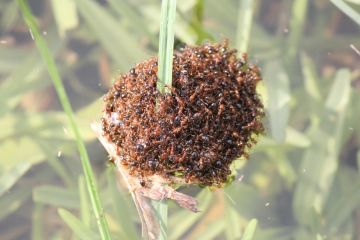
- Fire ants can form rafts during flood events, stowaway in freight or soil or spread by Queen ant flights of around 5 km per year (and up to 30 km in favourable conditions).
- The National Red Imported Fire Ant Eradication Program strategic review estimated that at least $200 to $300 million per year will be required for ongoing eradication efforts to achieve eradication by 2032 – this compares to $94 million spent in 2022/23 and only $60 million committed for this financial year.
- Recently, Australia’s governments committed to ongoing fire ant eradication but have not yet committed any new funding to fight fire ants in Australia. Fire ant eradication is being led by the Queensland government but is funded by all Australian governments because fire ants are a threat to the whole country.
- Fire ants came into Australia in the late 90s in freight from the United States, they were found in 2001. Fire ants are originally from South America.
- Fire ants have spread across most of the southern United States, and are spreading in China at a rate of about 80 km per year.
- Almost all of Australia is climatically suitable for fire ants.
- A comprehensive government study from 2021 found that between $200 and $300 million annually would be required over the next 10 years or Australia would face at least a $2 billion cost per year from fire ants forever. At the moment the planned funding is only half that amount.
Related Content