The Invasive Species Council has welcomed today’s announcement by NSW Agriculture Minister Tara Moriarty of a dedicated fire ant taskforce, following confirmation that the fire ant nest detected at Auburn contained multiple queens.
The Council says the discovery makes freight tracing even more critical, warning that the risk extends well beyond Sydney and that authorities must urgently establish whether fire ants could have been transported to other parts of the country from the infested site.
‘We welcome the NSW government’s establishment of a dedicated fire ant taskforce and its recognition of the seriousness of this threat,’ Invasive Species Council Advocacy Director Reece Pianta said.
‘The confirmation that this nest contained multiple queens is concerning, but it does not change our confidence that fire ants can be eradicated from Sydney if the necessary resources are put into the response.
‘Multiple-queen fire ant colonies, known as polygyne colonies, can spread rapidly and establish new nests nearby, making it particularly important that authorities identify the full extent of this infestation.
‘Multi-queen colonies are not new to Australia and their eradication has been a priority for the national eradication program. Australia has a good track record at dealing with multi-queen fire ant infestations.
‘Freight tracing has never been more important. Given the proximity of this detection to major freight and logistics operations and the potential age of the nest, we need to establish what materials have moved from this site, where they have gone and whether fire ants could have travelled with them.
‘This is not just a threat to Sydney. We need to make sure fire ants have not already hitchhiked their way to other parts of NSW or interstate. Sydney is a major freight hub with connections right across the country.
‘Right now, the eyes of the community are one of our most important biosecurity defences. Every freight worker, landscaper, gardener and resident has a role to play in making sure we find any other nests before they have a chance to spread further.
‘In Queensland, around 70 to 80 per cent of fire ant detections come from members of the public. We need that same level of community vigilance in Sydney.
‘We have successfully eradicated fire ants from Sydney before, at Port Botany. While that was not a multiple-queen infestation, there is enormous expertise within the national fire ant eradication program in tackling polygyne infestations.
‘Today’s announcement from the NSW government is welcome, but we also need governments across Australia to commit to fully funding the next phase of the national fire ant eradication program.
‘Over decades, Australia has built up world-leading expertise in detecting, treating and eradicating these dangerous ants. What we are seeing in Sydney right now is precisely why maintaining that expertise and national eradication capability is so critical for every state and territory.
‘Governments cannot afford to wait until the current funding runs out in June 2027 to make that commitment. We need funding certainty now.
‘Fire ants are a national threat that requires a national response. Allowing them to establish and spread across Australia would have devastating consequences for our native wildlife, agriculture, economy and the way we live.
‘We are urging Sydneysiders, particularly those living or working around Auburn and Enfield, to keep an eye out for suspicious ants or nests. Don’t disturb them – take a photo from a safe distance and report them immediately. Your report could be the difference between a successful eradication and a much larger infestation.’
Media enquiries: (02) 8006 5004
Background:
- On 23 November 2026, the NSW government confirmed a red imported fire ant nest had been detected and treated at Auburn, more than six kilometres from the original Enfield detection. On 25 November 2026, NSW Agriculture Minister Tara Moriarty confirmed the Auburn nest was polygyne, meaning it contained multiple queens.
- Polygyne fire ant colonies can establish new nests through a process known as budding, where queens and workers move away from an existing colony.
- Australia has previously successfully eradicated fire ant incursions in Port Botany, Gladstone and Perth.
- The national fire ant eradication program is currently funded until June 2027. The Invasive Species Council is calling for governments to commit $300 million annually through to 2032 to achieve eradication.
- Fire ants could cost Australia $2 billion annually if allowed to spread unchecked.
- Fire ants are dark reddish-brown with a darker black-brown abdomen and range from two to six millimetres long. Their nests can appear as mounds of loose, crumbly or fluffy-looking soil, often with no obvious entrance holes.
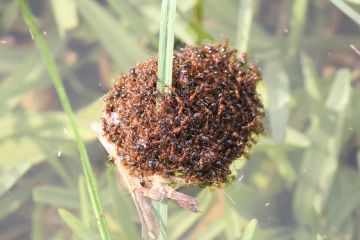
- During floods, fire ants can link together to form floating rafts containing thousands of ants and queens, allowing colonies to survive inundation and move with floodwaters.
- Fire ants can sting people, pets and livestock, kill native animals, damage crops and agricultural equipment and have major impacts on ecosystems.
- Anyone who suspects fire ants should leave them undisturbed, take a photo from a safe distance and report them on 1800 680 244 or at www.nsw.gov.au/fireants.
Related Content