The Invasive Species Council says the discovery of fire ant nests at a Defence base in Cabarlah, north of Toowoomba, is a stark reminder that only full eradication of fire ants can stop outlier outbreaks from occurring.
The Council has welcomed the rapid response to the detection, but warned that as long as a large domestic fire ant infestation remains in South East Queensland, outlier events like Cabarlah will keep happening – despite increasingly effective containment measures.
According to the National Fire Ant Eradication Program:
- suspect fire ant nests were found by Downer Defence during proactive surveillance at Borneo Barracks in Cabarlah and reported to the program on 15 October
- the detection is outside the program’s containment boundary
- program officers destroyed the nests within 24 hours, and treatment and surveillance will extend up to 500 metres from the detection site
- genetic testing is still underway to determine where the ants came from.
The detection as an example of Australia’s biosecurity system working as intended. The Council agrees the response was swift, but says the bigger lesson is that the fire ants got there at all.
‘Defence and the eradication program found these nests and acted quickly, but we can’t keep relying on luck and fast reflexes,’ Invasive Species Council Advocacy Director Reece Pianta said.
‘Containment buys time, but it cannot deliver certainty. While a domestic fire ant infestation exists, there will always be a pot plant, a load of soil, a turf delivery or a truck that slips through. No containment system – no matter how well run – can stop 100% of fire ant spread.
‘Every outlier is a roll of the dice. This time the nests were found on a secure Defence site with active surveillance. The next one could land in a backyard, a farm or a creek bank where nobody is looking, and be left to mature and spread for months or years.
‘The only system that can stop outliers like Cabarlah from happening in the first place is one that removes the source – and that means eradication.
‘Eradication is expensive, but containment is not a cheaper option. It is a permanent bill, paid forever, with a steady stream of outbreaks like this one on top.
‘The national eradication program is only funded until June 2027. Agriculture ministers have backed keeping eradication on the table. Now treasurers need to fund it in full, before the next outlier turns into the next infestation.
‘We also want the results of the genetic testing made public as soon as they are available, so the community understands how these ants reached Cabarlah and what is being done to close that pathway.’
Media inquiries: (02) 8006 5004
Background:
- On 15 October 2026, Downer Defence reported suspect fire ant nests found during proactive surveillance at Borneo Barracks, Cabarlah, in the Toowoomba region. The National Fire Ant Eradication Program destroyed the nests by direct injection, confirmed them as fire ants, and announced the detection on 21 October. Genetic testing to find the source is underway. (source)
- Fire ant detections outside the containment boundary are known as outlier detections. They occur when fire ants are carried out of infested areas, most often in soil, turf, mulch, potted plants, hay and other materials, or on vehicles and machinery.
- Fire ant colonies can reproduce after around six months. These reproduction events can infest freight and materials, and this has caused previous outlier detections, including in the Northern Rivers region of NSW.
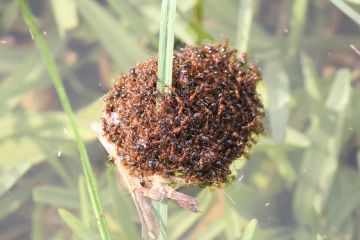
- Fire ants can also form rafts during flood events and spread by queen ant flights of around 5 km per year (and up to 30 km in favourable conditions).
- Fire ants can be lethal to humans, are expected to have a $2 billion per year impact on Australia’s economy if they get out of control, will devastate wildlife and could cut agricultural output by up to 40%.
- Red imported fire ants could cause 650,000 additional medical appointments every year if they are allowed to spread unchecked across Australia.
- Fire ant stings carry an anaphylaxis rate nearly three times higher than common stinging insects like bees.
- The current national fire ant eradication program is funded until June 2027.
- Agriculture ministers from across the country recently made a united commitment to keep fire ant eradication on the table, saying the next critical test is whether state, territory and federal treasurers will fund the plan.
- A proposed Response Plan 2027–32 would continue the eradication effort over the following five years, subject to funding commitments from Australian, state and territory governments.
- More than 95% of Australia is suitable for fire ant infestation.
Related Content