The Invasive Species Council has welcomed moves by Kangaroo Island Council to ask the South Australian government to consider a ‘last cat policy’, saying it could be the decisive step needed to finish one of Australia’s most ambitious feral cat eradication efforts.
If successful, the eradication program currently underway on the Dudley Peninsula will be the largest feral cat eradication ever undertaken on an inhabited island anywhere in the world.
The Council’s proposed policy would phase out cats over time by preventing new cats from being brought onto the island, while allowing existing pets to live out their lives.
On Kangaroo Island, the Council has a by-law already in place, which requires all cat owners to ensure domestic cats are effectively confined to the premises or under effective control by means of a physical restraint (ie, within a cage or on a lead). This is as strong a position as Council can take within the existing legislation, and a ‘last cat’ policy will require a declaration by the state government under the Landscapes South Australia Act.
‘After years of hard work and millions of dollars invested, Kangaroo Island is on the brink of something extraordinary, but it only takes one person with a pair of undesexed pet cats to undo that progress and start the problem all over again,’ Invasive Species Council CEO Jack Gough said.
‘This policy proposal is a positive indication of where community sentiment has shifted on this issue, and shows that people understand Australia’s wildlife is too important to be threatened by feral and roaming pet cats.
‘This is not about taking people’s pets away, it’s about making sure future generations don’t inherit the same problem we’ve spent decades trying to fix.
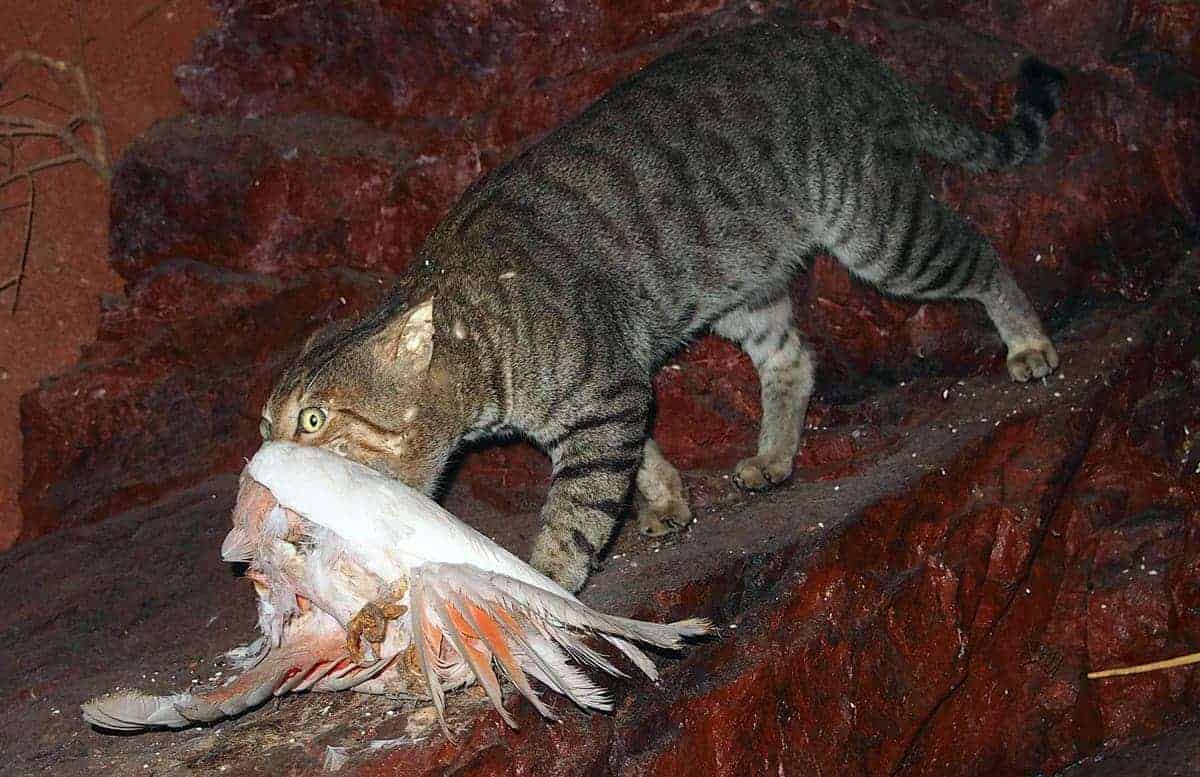
‘Feral cats are one of the leading drivers of wildlife decline in Australia, and on Kangaroo Island alone, they prey on more than 50 native species, including threatened animals found nowhere else on Earth.
‘Cats also spread diseases such as toxoplasmosis, which impacts livestock production and causes significant economic losses for farmers.
‘Kangaroo Island has a rare chance to show what’s possible and spark a wildlife revival that will see populations of dunnarts, echidnas, penguins and other wildlife return that have been under constant pressure from predation.
‘The eradication program is entering its most challenging phase. The last cats are always the hardest to catch – they’re smart, trap-shy and incredibly resilient.
‘That’s why it’s so important we don’t allow new cats to re-establish populations just as we’re getting close to the finish line.
‘Recently the state government committed $1.5 million to get the Dudley done, but there is $3.1 million still required to finish the eradication program, and the Australian Government needs to step up to ensure KI can secure what would be the largest feral cat eradication ever completed on an inhabited island anywhere in the world – placing South Australia at the forefront of one of the most significant conservation achievements in our nation’s history.’
Media inquiries: (02) 8006 5004
Photos and maps to accompany this story are available here.
Background:
- Kangaroo Island is internationally renowned for its biodiversity, agriculture, and tourism, contributing $200 million annually to nature-based tourism and $150 million to sheep production pre-bushfires.
- Its unique ecosystems support threatened species such as the Southern Brown Bandicoot, Kangaroo Island Echidna, and Western Whipbird. Feral cats are their primary threat, causing catastrophic declines in native species and spreading diseases like toxoplasmosis, which also impacts agriculture.
- Feral cats are the apex predator on Kangaroo Island.
- Feral cats are known to predate on over 50 native species on Kangaroo Island.
- Cats are hosts to diseases and parasites that place the endangered Australian sea lion at increased risk of extinction.
- The program has successfully reduced the cat population down to just 150, using state-of-the-art AI cameras and trapping technologies.
Related Content