




An invasive fire ant nest has been destroyed inside one of Australia’s most iconic World Heritage rainforests, highlighting both the ongoing threat fire ants pose to treasured natural places and the critical importance of fully funded eradication.
The nest was detected in a forest clearing on a private property surrounded by Lamington National Park in the Gold Coast hinterland – a premier section of the Gondwana Rainforests of Australia. The ancient rainforest is internationally recognised for its extraordinary biodiversity and deep ecological history stretching back to Gondwana.
Invasive Species Council Advocacy Director Reece Pianta said the detection was deeply concerning but showed just how critical rapid response programs are in the fire ant fight.
‘Fire ants are one of the worst invasive threats to Australia’s wildlife and a failure to eradicate them in south-east Queensland will see them spread across most of the country,’ he said.
‘To find a nest inside one of the world’s most ancient and beautiful rainforests is alarming. These places should be beyond the reach of invasive species.
‘Rainforest is an unusual habitat for fire ants, which shows just how adaptable and dangerous they are and why every part of Australia is at risk of fire ant infestation.
‘The program’s rapid response meant the nest was found and destroyed before it could spread. That’s exactly how eradication is supposed to work. The park is protected because the system responded fast.
‘Every successful response protects irreplaceable natural heritage. But eradication only works if teams can move fast and have the resources they need.
‘Bureaucratic funding delays to the next phase of fire ant eradication cannot be allowed to impair the program’s ability to respond quickly, or we will see more national treasures like this impacted.
‘It is in our DNA as Australians to protect the natural treasures we love, and it is the government’s responsibility to ensure they are preserved for generations to come.
‘Prime Minister Albanese, we need you to save Australia from fire ants by committing the funds needed to get the job done. Whether we win or lose this fight is in your hands.’
Media inquiries: (02) 8006 5004
Fire ant images are available here.
Background:
- Fire ants can be lethal to humans, are expected to have a $2 billion per year impact on Australia’s economy if they get out of control, will devastate wildlife, cut agricultural output by up to 40% and may cause over one hundred thousand extra medical appointments each year.
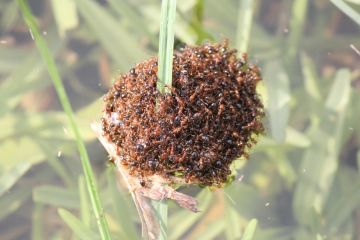
- Fire ants can form rafts during flood events, stowaway in freight or soil or spread by Queen ant flights of around 5 km per year (and up to 30 km in favourable conditions).
- The National Red Imported Fire Ant Eradication Program strategic review estimated that at least $200 to $300 million per year will be required for ongoing eradication efforts to achieve eradication by 2032 – this compares to $94 million spent in 2022/23 and only $60 million committed for this financial year.
- Recently, Australia’s governments committed to ongoing fire ant eradication but have not yet committed any new funding to fight fire ants in Australia. Fire ant eradication is being led by the Queensland government but is funded by all Australian governments because fire ants are a threat to the whole country.
- Fire ants came into Australia in the late 90s in freight from the United States, they were found in 2001. Fire ants are originally from South America.
- Fire ants have spread across most of the southern United States, and are spreading in China at a rate of about 80 km per year.
- Almost all of Australia is climatically suitable for fire ants.
- A comprehensive government study from 2021 found that between $200 and $300 million annually would be required over the next 10 years or Australia would face at least a $2 billion cost per year from fire ants forever. At the moment the planned funding is only half that amount.
Related Content