MEET THE INVADERS
Feral Deer
Deer are agile herbivores with sharp senses and an uncanny ability to disappear into the landscape. Always alert, they detect danger from a distance and can bolt at a moment’s notice.
Six deer species have successfully invaded Australia:
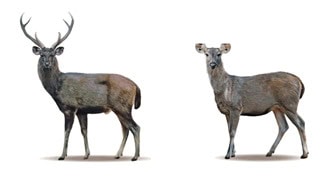
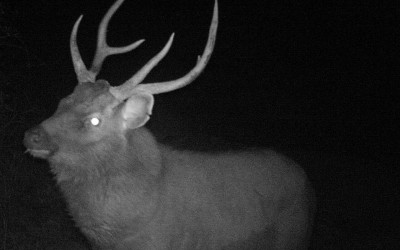
Sambar (Cervus unicolor): Native to the Indian subcontinent, Southeast Asia, and parts of East Asia. They are the largest, with some males weighing up to 300 kg.
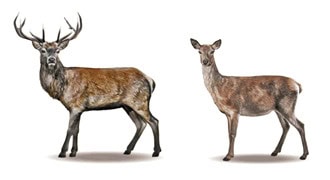
Red (Cervus elaphus): Originally found across Europe, parts of Asia and North Africa. These deer form herds, with males weighing up to 220 kg.
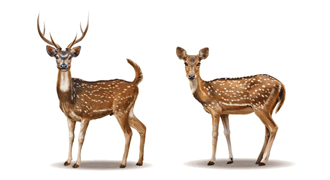
Chital (Axis axis): Native to the Indian subcontinent, primarily found in India, Nepal, and Sri Lanka. They form groups that may number 1 to 150 or more individuals, depending on habitat.
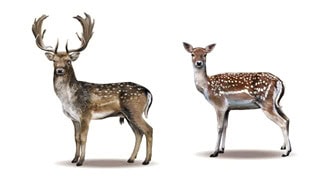
Fallow (Dama dama): Native to the Mediterranean region and parts of Europe, with populations also in Asia Minor. They are also herd-forming, with males weighing up to 100kg.
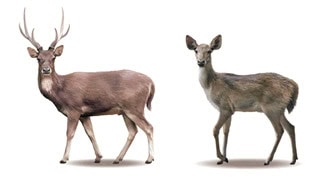
Rusa (Cervus timorensis): Native to the islands of Southeast Asia, including Indonesia and Timor. They often form small groups rather than huge herds.
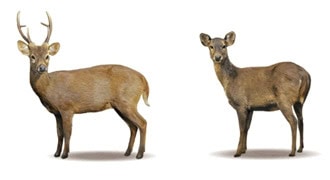
Hog (Axis porcinus): Native to the Indian subcontinent and parts of Southeast Asia. The smallest of deer species in Australia, weighing up to 55kg and living usually solitary or in very small groups.
In their native ranges, predators like wolves, bears and big cats keep their numbers in check², but in the absence of these, deer populations can quickly swell.
Deer can live very social lives. Most species form herds or family groups with females (does) banding together to raise their young. Males (stags or bucks), meanwhile, tend to keep their distance until breeding season kicks in. That breeding season is known as the ‘rut’ – and it’s a dramatic affair.
Every year, usually around Autumn for the common species including fallow and red deer, male deer battle it out to find the right mate.
Some species roar, crash antlers and parade their size and strength. In most species, one dominant male will win mating rights to multiple females. Once mating is done, usually 1 young (fawn) is born, after 7–8 months of gestation.
Deer are opportunistic feeders and browse from the ground to as high as they can stretch. They eat a diverse diet of plants, with some species mainly grazing on grasses, sedges and herbs, and others browsing leaves, fruits and shoots, or a combination of both.
Deer don’t just eat plants – they help spread them too, including weeds. Every day, a single hog deer can deposit up to 494 viable seeds, giving plants a free ride to new locations.
Invasion story
In the 1800s, British settlers wanted to make Australia feel more like home.
Enter the acclimatisation societies – groups dedicated to introducing animals and plants for varying purposes from recreational hunting and aesthetics, to farming and food supply¹. Among their cargo? Deer.
18 species were shipped over, but only 6 survived and established wild populations: fallow, sambar, red, rusa, chital and hog deer⁵. Some escaped from private hunting reserves; others were deliberately set loose to create a ‘sporting’ landscape⁵.
For most of the 20th century, deer populations remained relatively small and localised.
In 1980 there were an estimated 50,000 deer nationwide⁵.
Then came the rise of deer farming in the 1970s and 80s which led to more escapes and illegal releases. But when the meat and velvet market failed to fully take off – many deer were simply released. Some farmers even freed their herds when the value of venison collapsed, seeding wild populations that persist today.
By 2002, the estimated numbers had risen to 170,000 with 35% of wild populations coming from farm escapes, and 58% from translocations, presumably for hunting⁵.
In New South Wales, their range expanded by 30% from 2005 to 2009, then another 30% between 2009 and 2016⁴. By 2020 feral deer occupied 180,000 square kilometres – nearly a quarter of the state – up from 138,000 square kilometres in 2016⁴.
Tasmania saw its fallow deer population triple between the early 1970s and 2007, with their range expanding from 400,000 hectares to 2.1 million hectares³. There could be up to 100,000 deer across 27% of Tasmania, and that number could grow to more than 1 million by 2050.
But it is Victoria that has been hit the hardest by this invasion. It is estimated that there are over 1 million deer occupying nearly 40% of the state. Projections indicate that, without significant management intervention, the population could escalate to between 1.7 and 4.6 million by 2050. This invasion includes some of the state’s finest natural and protected areas, like almost all of Victoria’s national parks from the coast to the high country, including its highest peak on Mount Bogong.
The explosion of deer numbers in the last 30–40 years due to a perfect storm of factors. Farm escapes and illegal releases have fueled population growth⁵. As is a lack of effective management in some states due to laws that protect them for recreational hunting. Bushfires also clear land, creating open spaces with fresh regrowth – prime real estate for deer⁵.
Today, wild deer aren’t confined to the south-east anymore. Established populations of red, fallow, chital and rusa deer are now found in Queensland, while fallow, red and rusa are declared pests in Western Australia.
They’ve even made it onto some islands – for example, rusa deer were introduced to Wild Duck Island off the Queensland coast but thankfully have since been eradicated to protect turtle nesting sites.
Today, at least one type of wild deer is found in every state and territory. The latest population estimate from 2022 predicts anywhere from 1 to 2 million roaming across the country⁴.
And it’s not just rural areas – deer are increasingly turning up in suburban parks, golf courses, homes and shopping centres⁴.
Climate and habitat suitability modeling predict that, without control measures, feral deer could inhabit virtually every habitat in Australia.
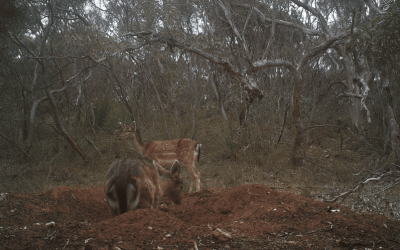
Image: Trampled earth from feral deer
How did we get here?
Historically, deer were considered to do little harm in the Australian landscape⁵.
This myth persisted for decades, motivated in part by the valuing of deer for recreational hunting ⁴.
Such was the value placed on deer that Victoria, New South Wales and Tasmania protected them for hunters and made it difficult for landholders to control them.
Increasing deer populations have exposed significant policy failures. Despite mounting evidence of damage, governments were slow to respond, with outdated laws hindering effective management. Until 2019, deer in NSW were protected as game animals and private landowners were required to obtain a game hunting license to manage deer and subject to restrictions that prevented effective management⁴.
In Victoria feral deer are classified as ‘protected wildlife’ under the Wildlife Act even though sambar are also listed as a ‘potentially threatening process’ under the Threatened Species Protection Act⁴.
In Tasmania feral deer are listed as ‘partly protected’ wildlife, and have been managed mainly as a hunting resource rather than a harmful invasive animal.
More recently, there has been some shift as the evidence for severe environmental, agricultural and social damage by deer has become undeniable.
In 2019 NSW, deer lost their status as protected game animals, removing a major barrier to control. In Victoria, the 2020 Deer Control Strategy recognised deer as a major threat to biodiversity, aiming to simplify control measures and coordinate regional efforts.
In 2020 the Australian Government appointed a National Deer Management Coordinator and in August 2023, a major milestone was achieved – the official adoption of the National Feral Deer Action Plan.
In South Australia, deer have been declared a pest species statewide and an ambitious country-leading eradication program was started in 2022.
In 2024, Tasmania managed to clear the Walls of Jerusalem National Park in the Tasmanian Wilderness World Heritage Area from feral deer as a result of a successful aerial culling program.
But challenges remain.
While momentum is growing, so too are deer numbers.
Without sustained commitment and funding from all levels of government, we risk losing ground – and losing more of our natural heritage.
The toll on nature
Australia did not evolve to withstand the trampling and browsing of hooved animals.
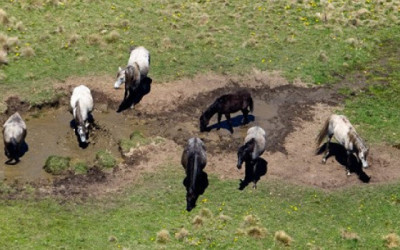
The relentless trampling of deer compacts soil, strips vegetation and leaves water sources muddied and degraded².
Their browsing pressure – the way they eat low plants, saplings and shoots – is particularly devastating after bushfires, preventing native plant species from regenerating while allowing weeds to take hold⁷.
In Victoria’s Genoa River region, gaps created by deer have been overrun by cape ivy and Madeira winter-cherry, choking out native shrubs and trees⁵.
At least 13 endangered plant species and 12 threatened ecological communities (a group of living things coexisting in one place) are under threat from feral deer in Victoria⁴. This is because deer trample and browse vegetation and seedlings and break or ring-bark young trees, which alters the whole plant community.
In NSW’s coastal rainforests, deer browsing, trampling and rubbing is threatening native plants and animals, and degrading the critically endangered ecological community Littoral Rainforest and Coastal Vine Thickets of Eastern Australia⁴.
In Royal National Park, rusa deer have torn into, flattened and consumed 3 types of habitats so much that plant diversity has been slashed from 27 to 54%⁵.
In Tasmania there are concerns that large fires in the Tarkine could create new feeding grounds for fallow deer, enabling rapid expansion⁶. This could devastate regeneration efforts in World Heritage forests, leaving fire-ravaged landscapes struggling to recover.
If deer populations in Australia continue to increase at their current rate, their impacts are likely to rival those of both feral pigs and feral goats in the near future⁵.
Feral deer aren’t just an environmental concern, they are a human safety risk as well. In the Illawarra region of New South Wales, between 2005 and 2017, there were 107 motor vehicle accidents involving deer, 90 of which were classified as 'serious.' These incidents resulted in 28 injuries and one fatality.
Cultural consequences
Feral deer are also damaging Indigenous cultural heritage. The Gunaikurnai Land and Water Aboriginal Corporation and the Dja Dja Wurrung Clans Aboriginal Corporation have raised concerns over deer compacting soil, eroding cultural sites and competing with native species for food in significant landscapes across Gippsland and Central Victoria. Without intervention, vital cultural and environmental sites risk permanent damage.
How do we fix this?
Feral deer are a rabbit plague in the making. And we have a small window of opportunity to get ahead before their numbers reach catastrophic levels.
Typically, the most effective method for controlling feral deer is aerial shooting. Unlike recreational hunting, which removes too few animals to keep populations in check, aerial culling is strategic, humane and highly efficient.
No one likes to see animals killed, but the sad reality is that we have a choice to make between urgently reducing numbers of feral deer or accepting the extinction of native plants and animals.
In places like South Australia and Tasmania, well-planned aerial control programs have drastically reduced or eradicated deer numbers in priority areas, allowing places like the Walls of Jerusalem National Park in the Tasmanian Wilderness World Heritage Area to recover. The challenge is ensuring these programs are maintained and adequately funded. Legal changes are needed in Tasmania and Victoria to fully recognise deer as a major threat and remove impediments to effective management.
National coordination, funding and research are also essential.
The National Feral Deer Action Plan, adopted in August 2023, is our best shot at turning the tide. It sets ambitious targets for containing and reducing deer populations. But more funding is needed for large-scale control programs, research into more effective management strategies and coordination between states to ensure efforts aren’t undermined by inconsistent policies.
However, the hunting lobby continues to push back against stronger regulations and effective control programs, arguing that deer should remain a recreational hunting resource rather than a declared pest.
The Invasive Species Council has campaigned for over 20 years to get deer recognised not as game, but as the serious environmental threat they are. We’ve helped lead the push for legislative reform, national coordination and investment in control programs.
There is still time to stop feral deer before they become Australia’s next rabbit plague – but only if governments fully commit to action.
FAQs
Deer were introduced for hunting in the 19th century. Their populations grew through releases by acclimatisation societies, escapes from farms and translocations for hunting.
Feral deer damage native plants, compete with native wildlife, harm agriculture, cause vehicle accidents, can spread disease and impact Indigenous cultural sites.
Feral deer are widespread across eastern and southern Australia, with specific species more common in certain states, like sambar in Victoria and fallow in Tasmania.
Deer are partially protected in Victoria and Tasmania for hunting.
Efforts include aerial and ground shooting and fencing. Recreational hunting isnot an effective control method on its own and can sometimes lead to species being deliberately spread.
Challenges include conflicting goals between conservation and hunting, ongoing deer releases, limited awareness and some opposition to aerial shooting.
Priorities include full implementation of the national action plan, more funding, policy reform, stricter regulations on deer farms, further research and greater community awareness.
- Hull, G. (2021). The Ferals that ate Australia. Black Inc.
- Rowland, PI & Lovelock, CE 2024, ‘Global impacts of introduced ungulates on wetland carbon and biodiversity: A review’, Biological Conservation, vol. 290, 110432, viewed 4 April 2025, https://doi.org/10.1016/j.biocon.2023.110432.
- Potts, JM, Beeton, NJ, Bowman, DMJS, Williamson, GJ, Lefroy, EC & Johnson, CN 2015, ‘Predicting the future range and abundance of fallow deer in Tasmania, Australia’, Wildlife Research, vol. 41, no. 8, pp. 633–640, viewed 4 April 2025, https://doi.org/10.1071/WR13206.
- Senate Environment and Communications References Committee 2021, Impact of feral deer, pigs and goats in Australia, Parliament of Australia, Canberra, viewed 4 April 2025, https://www.aph.gov.au/Parliamentary_Business/Committees/Senate/Environment_and_Communications/FeralDeerPigsandGoats.
- Moriarty 2004: Moriarty A. (2004) Ecology and environmental impact of Javan rusa deer (Cervus timorensis russa)
- in the Royal National Park. PhD Thesis. University of Western Sydney, Sydney.
- Invasive Species Council 2020, Proposed Tasmanian wild fallow deer management plan: a submission by the Invasive Species Council, December 2020.
- Invasive Species Council. (2022). Feral Deer: A Protected Species or a Pest? Retrieved from https://invasives.org.au/wp-content/uploads/2022/09/Feral-Deer-A-protected-species-or-a-pest-Invasive-Species-Council.pdf
- Invasive Species Council 2018, ‘Feral deer putting NSW drivers at risk’, Invasive Species Council, viewed 4 April 2025, https://invasives.org.au/blog/feral-deer-putting-nsw-drivers-at-risk/.
- Jacobs, P. (2021). Feral Deer Control: A Strategy for Tasmania. Invasive Species Council. Retrieved from https://invasives.org.au/wp-content/uploads/2021/08/Feral-Deer-Control-A-Strategy-for-Tasmania-2021.pdf